The Subnasal Lip Lift
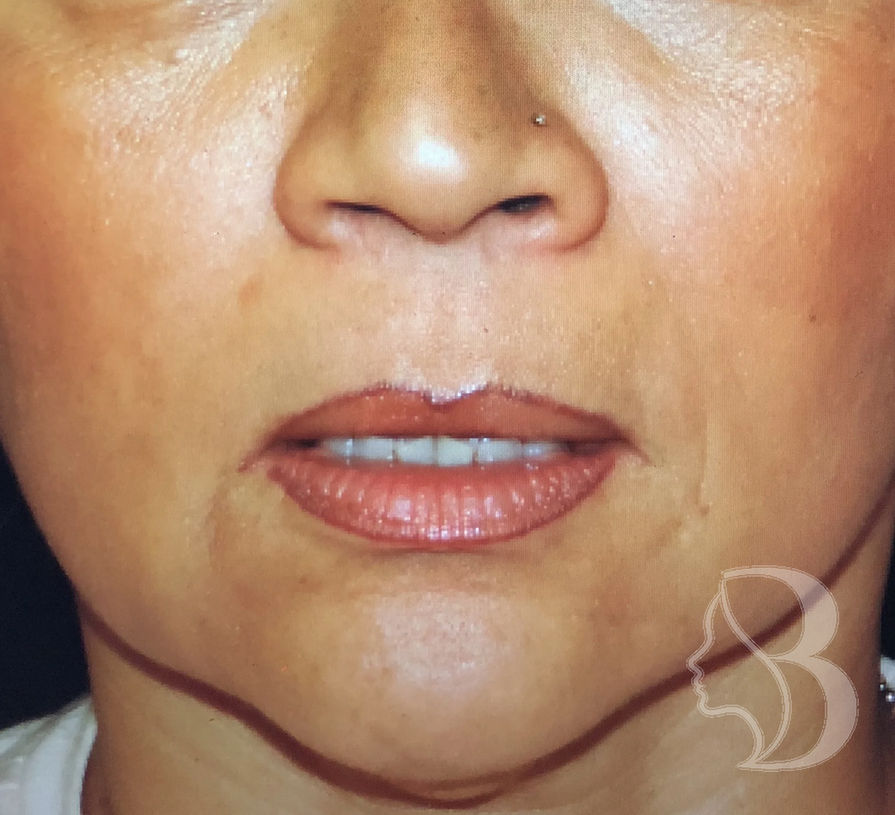
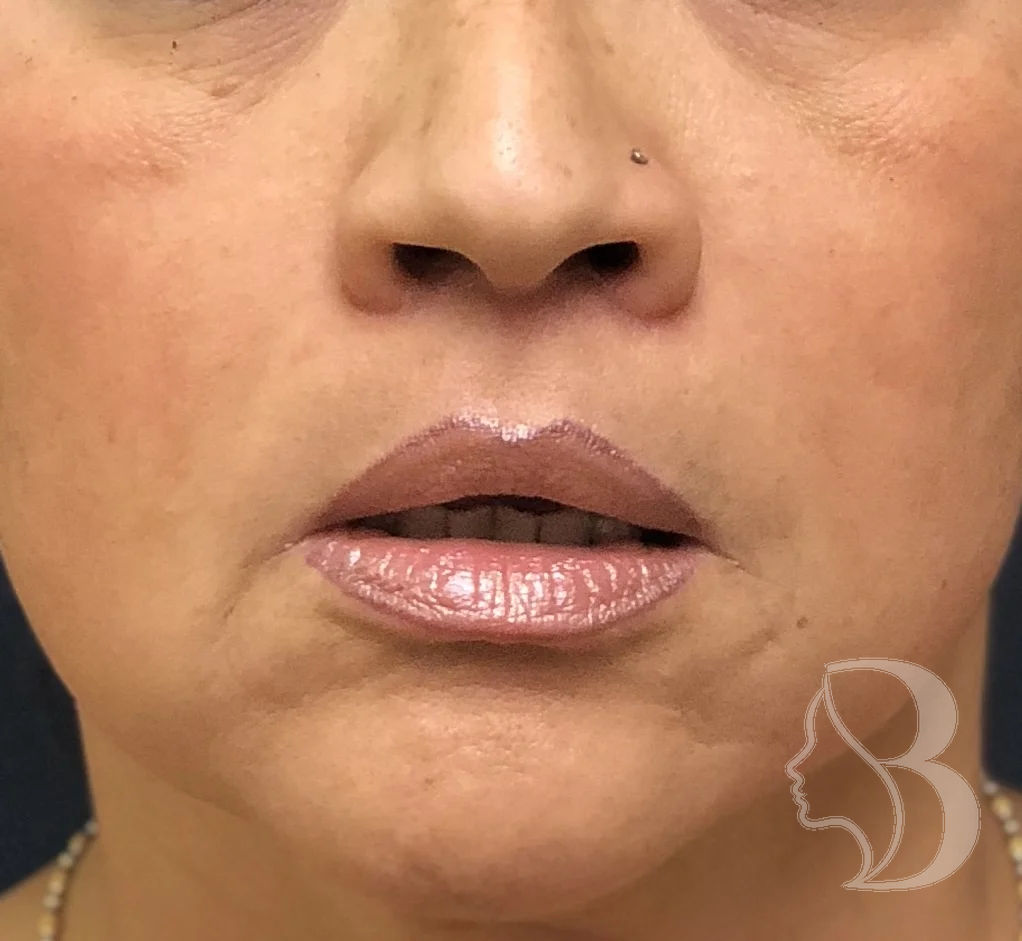
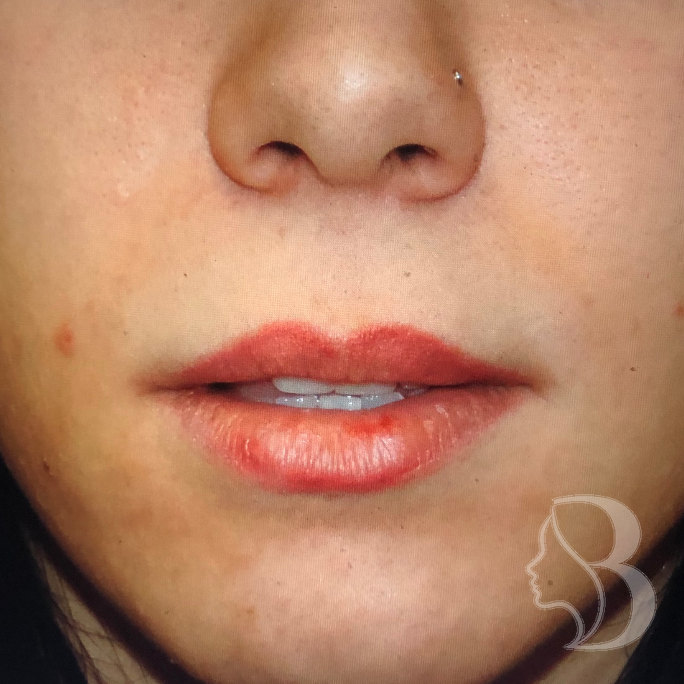
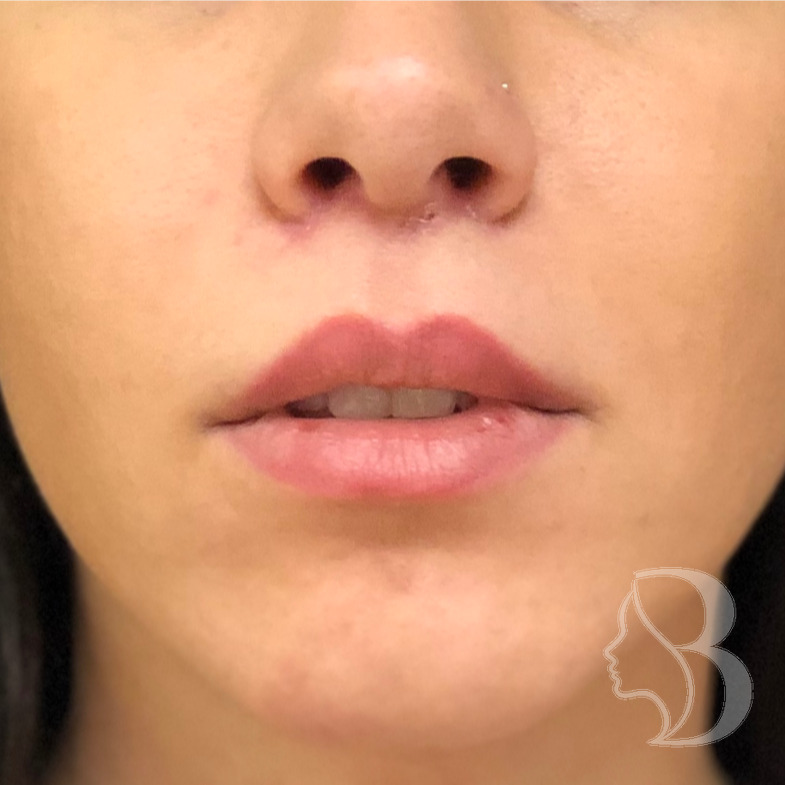
The subnasal lip lift — also called the bullhorn lip lift — is the gold-standard surgical technique for permanently shortening the philtrum, the vertical distance between the base of the nose and the top of the upper lip. By removing a precisely designed strip of skin at the base of the nose, Dr. Rafizadeh elevates the lip, rolls the vermilion outward, and increases how much of the upper teeth are visible at rest. The result is a more youthful, defined lip without adding artificial volume.
Dr. Rafizadeh has performed subnasal lip lifts since 2012 — well before the procedure entered mainstream plastic surgery. It is now one of his most-requested procedures. His signature technique — sometimes called an endonasal or hidden-scar lip lift — hides the incision inside the nostrils rather than at the base of the nose, making the scar substantially less visible than with the conventional placement.
Based in Morristown, New Jersey — approximately 40–45 minutes from Midtown Manhattan — Dr. Rafizadeh performs subnasal lip lifts for patients from across North Jersey (Morris County, Essex County, Bergen County, Somerset County, and Union County) as well as from New York City, Hoboken, Jersey City, and out-of-state. His early specialization in this procedure and hundreds of documented cases make him one of the most experienced subnasal lip lift surgeons in the NYC metro area.
“The incision has to live inside the nasal sill. I adapt the shape to each patient's anatomy — not everyone has the same curve at the base of their nose — because that's where the scar either disappears or stays visible for life.”
— Dr. Farhad Rafizadeh MD FACS
Why Philtrum Length Matters
The ideal philtrum measures 11–13 mm in women and 13–15 mm in men. With age, the philtrum elongates as skin laxity increases and the lip descends — a philtrum that was 12 mm at age 30 may reach 16–18 mm by the mid-40s. As it lengthens, the red vermilion rolls inward and becomes less visible, which is why patients often feel their lips have "disappeared" with age even though lip anatomy hasn't fundamentally changed. The subnasal lip lift directly corrects this by excising the excess and restoring a youthful philtrum-to-lip ratio.
Incision Design by Nasal Sill Morphology
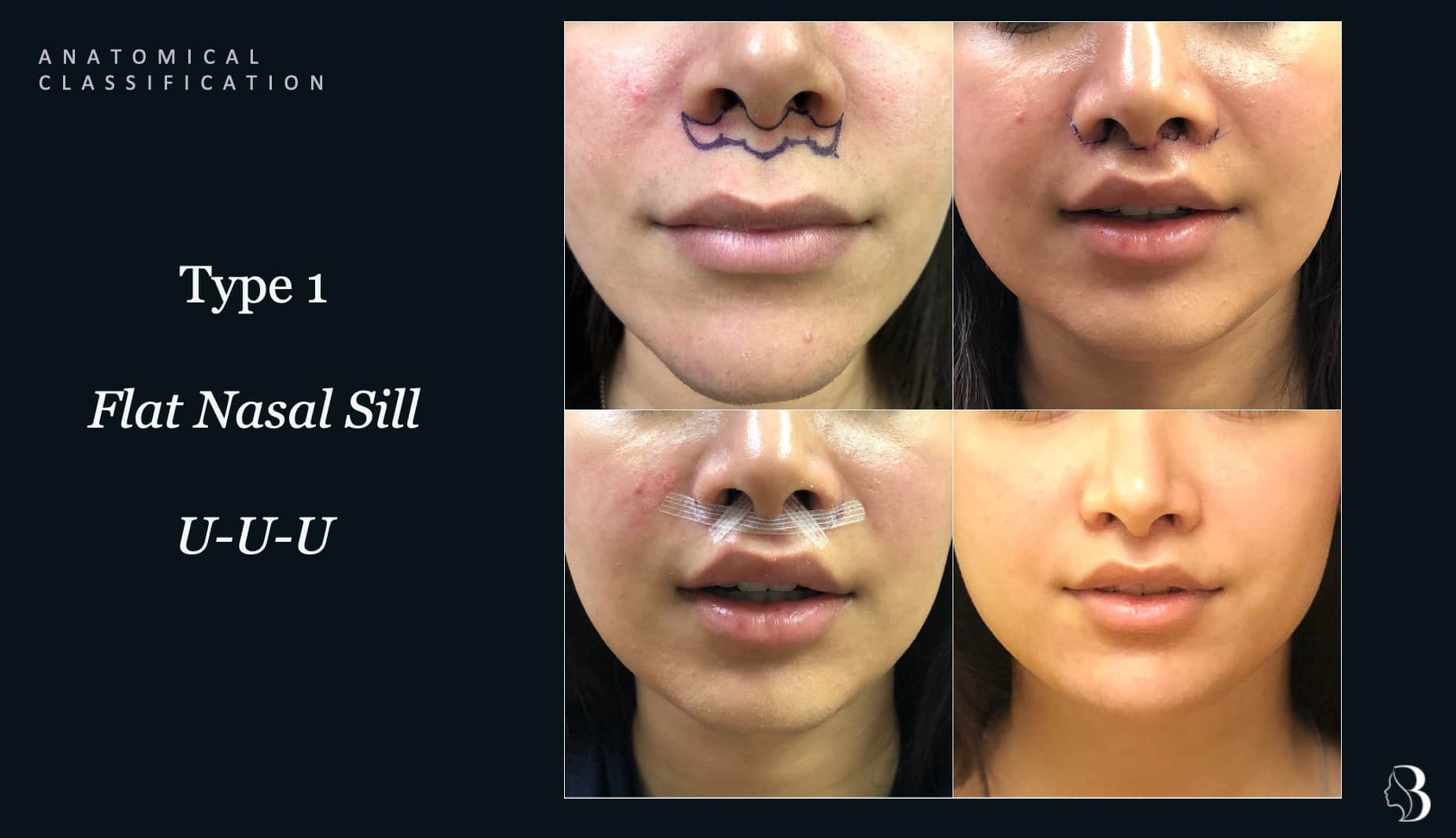
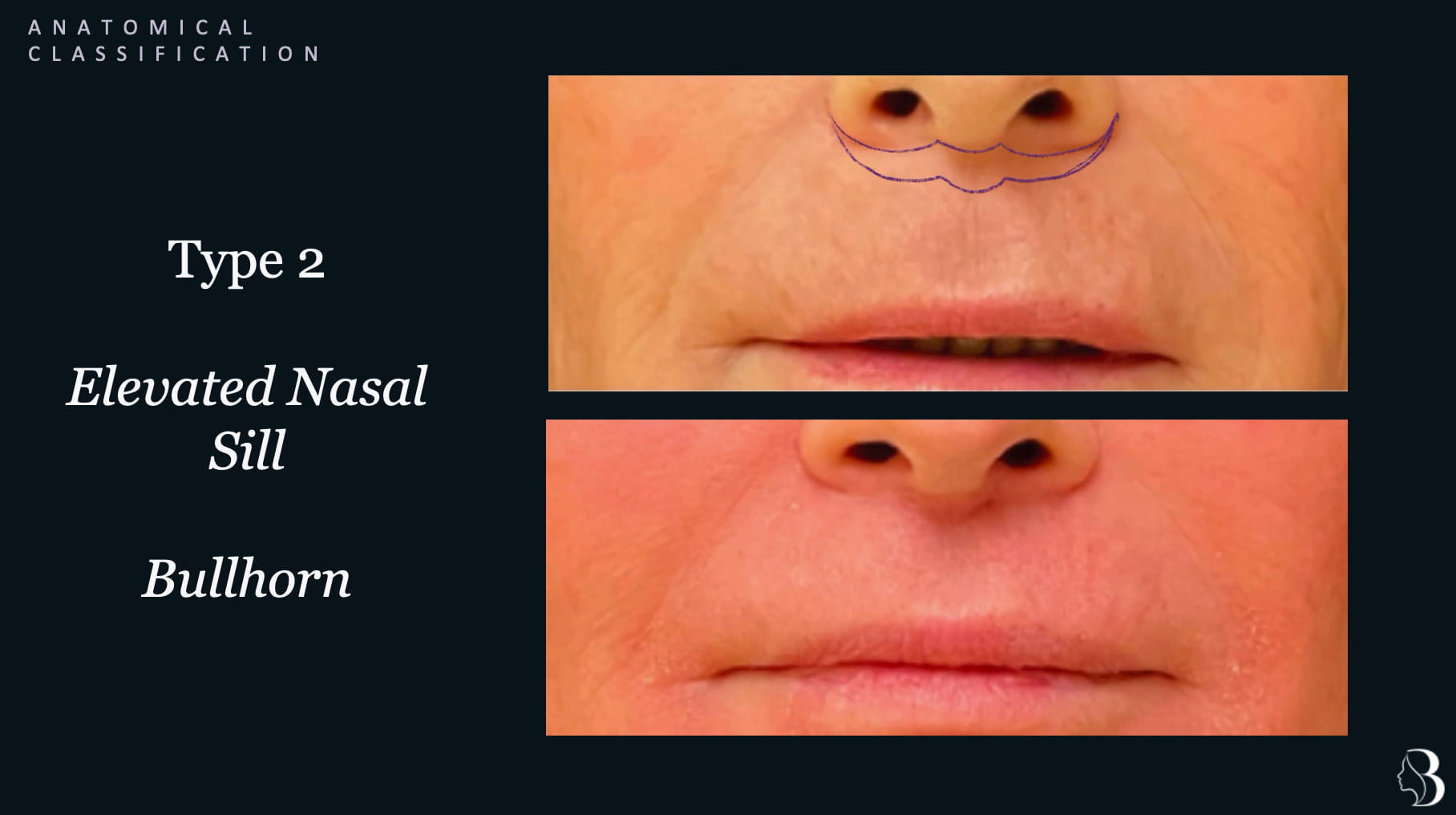
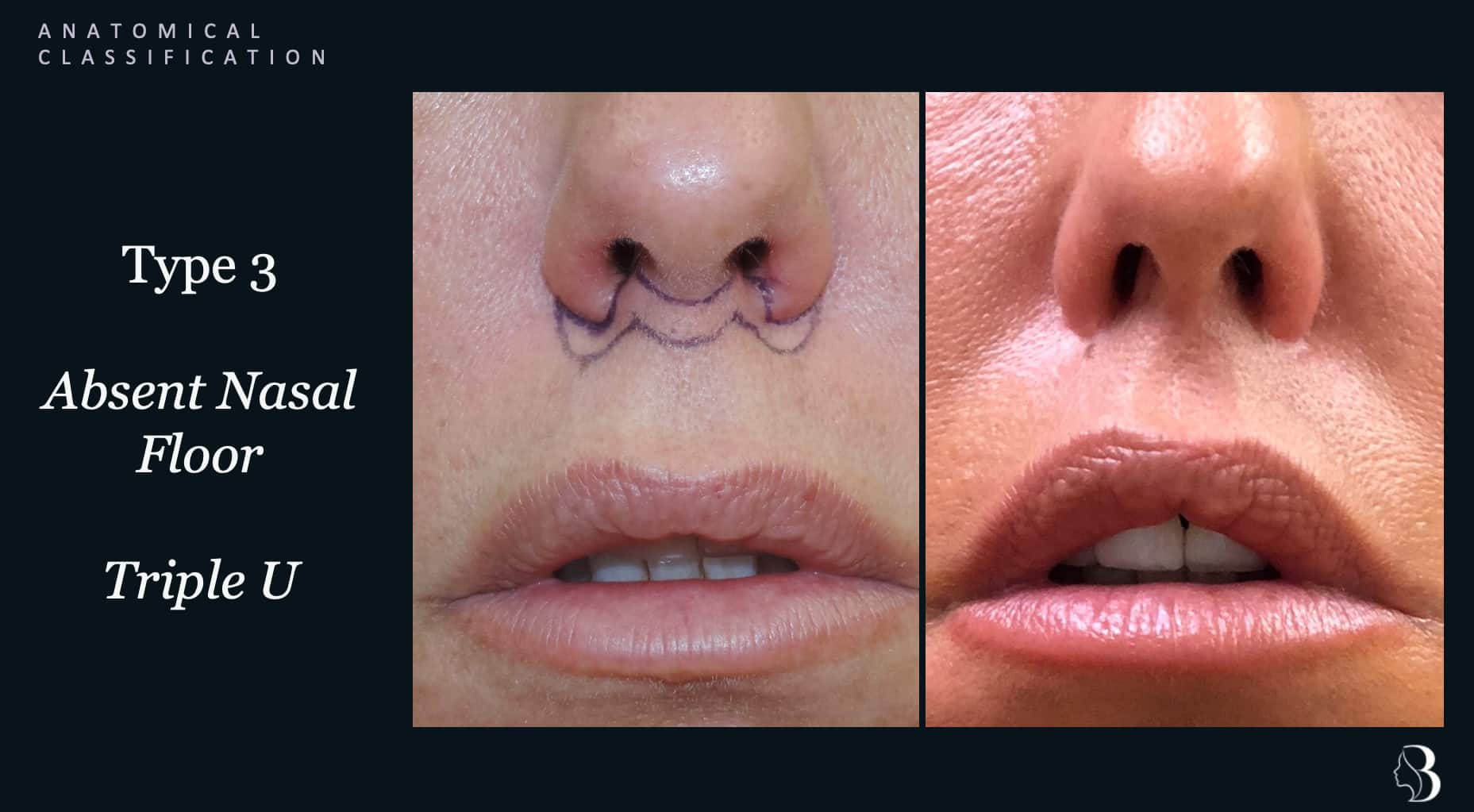
Not every patient receives an identical incision. Dr. Rafizadeh classifies each patient's nasal sill into one of three anatomical types and adapts the incision accordingly to ensure the scar is concealed in the natural shadow of the nasal base — regardless of individual anatomy.
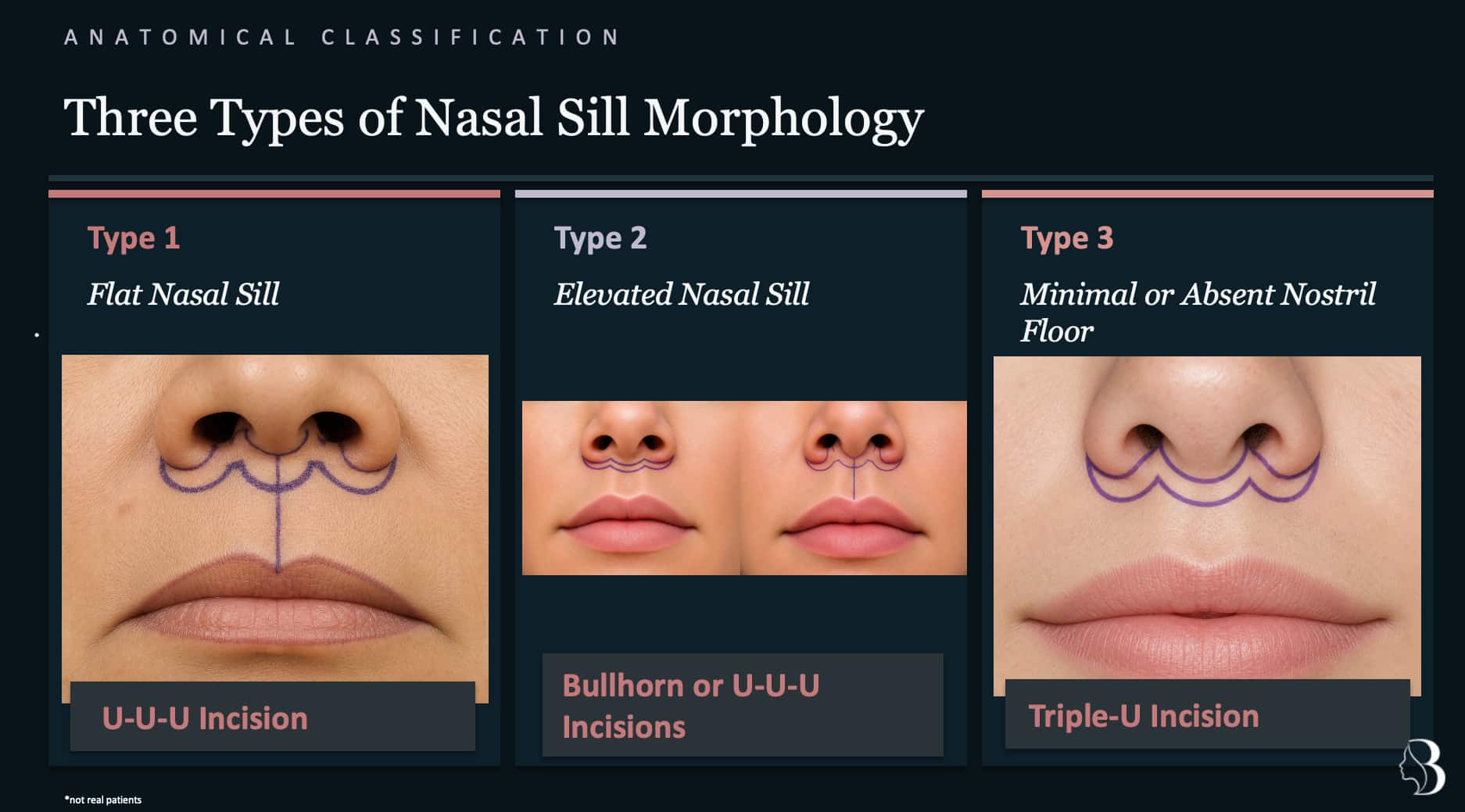
| Nasal Sill Type | Anatomy | Incision Design |
|---|---|---|
| Type 1 — Flat | Flat sill; no elevation between nose and lip skin | Modified U-U-U incision hugging the alar base |
| Type 2 — Elevated | Natural raised sill; classic nasal-lip groove | Classic bullhorn placed within the sill crease |
| Type 3 — Absent Floor | No defined sill; wide alar base | Triple-U variation with extended lateral limbs |
This morphology-based approach is what allows Dr. Rafizadeh to consistently place the scar in a location where it will be concealed within natural shadows and skin creases. Patients with Type 1 or Type 3 nasal sills require a modified incision — performing a standard bullhorn on these patients risks placing the scar in a visible, flat area of skin with no shadow for concealment.
→ Schedule a ConsultationMeet with Dr. Rafizadeh personally to discuss your goals and a personalized plan. Call (973) 267-0928 or request a consultation online.What the Procedure Improves
The subnasal lip lift is the most direct and reliable correction available for a set of concerns that filler and non-surgical treatments cannot fully address:
Long philtrum — Permanently shortened in a single procedure; no repeat treatments required.
Rolled-in or thin upper lip — Elevating the lip rotates the vermilion outward, making the red of the lip more visible without injecting volume.
Reduced tooth show at rest — Most patients gain 1–4 mm of additional upper incisor visibility, restoring the youthful dental display associated with a younger lip.
Loss of cupid's bow definition — The elevation naturally sharpens the cupid's bow as a secondary effect of the lift.
Filler fatigue — Patients who have repeatedly filled their lips seeking elevation that filler cannot provide. See: Lip Lift vs. Lip Filler — full comparison →
The Procedure — Step by Step
Marking and planning: Dr. Rafizadeh measures and marks the philtrum with the patient seated upright. The excision shape is drawn before any anesthesia — preserving natural gravity and lip tension so the mark represents the true resting anatomy.
Anesthesia: Local anesthetic (lidocaine with epinephrine) is injected. IV sedation is available for patients who prefer it.
Excision: The marked skin is removed with attention to depth — taking skin and a thin layer of subcutaneous tissue while preserving the orbicularis muscle beneath.
Closure: A two-layer closure using deep absorbable sutures and fine surface sutures minimizes tension on the skin edge and optimizes scar quality.
Recovery begins: The patient goes home the same day. Sutures are removed at 5–7 days.
Subnasal Lip Lift Recovery Timeline
Days 1–3: Swelling peaks; lips feel tight and tender. Soft foods, no puckering or stretching the lip.
Days 5–7: Sutures removed; most swelling has subsided; presentable with makeup coverage.
Weeks 2–4: Near-normal appearance; scar pink and slightly raised — this is normal and expected.
Months 1–3: Scar softens and fades; final lip position fully apparent.
6–12 Months: Scar fully matures; nearly imperceptible in most patients.
Subnasal Lip Lift Cost in New Jersey & the NYC Metro
The fee at Dr. Rafizadeh's Morristown practice typically ranges from $3,500 to $5,500, depending on whether the procedure is performed alone or combined with other surgeries. The same subnasal lip lift at a high-overhead Manhattan or New York City practice often runs $6,000 to $10,000+ — so patients traveling the ~40–45 minutes from NYC frequently find meaningfully lower fees without compromising on a board-certified surgeon who sub-specializes in the lip lift.
What the price includes. The quote is all-inclusive — covering the surgeon’s fee, the in-office procedure suite, local anesthesia, every follow-up visit, and suture removal — with no surprise facility or recovery-room charges added afterward. Because a subnasal lip lift is performed awake under local anesthesia, patients avoid the separate anesthesiologist and hospital-facility fees that inflate the cost of the same procedure at a Manhattan surgical center. If a corner lift or simultaneous rhinoplasty is added, each component is quoted and reviewed line by line at consultation. This is an elective cosmetic procedure — insurance does not apply.
Related Reading from Our Blog
Dr. Rafizadeh covers the questions subnasal lip lift patients across New Jersey and the NYC area ask most. These recent articles go deeper:
→ Lip Lift & Rhinoplasty Together: Philtrum LengthHow the base of the nose ties the subnasal lift to rhinoplasty — and why philtrum length guides both procedures. → Lip Lift Scars: Preventing Cross-Hatching & Fixing a Bad ScarWhat causes the deep “stitch-mark” scar at the base of the nose, how careful closure prevents it, and whether a poor scar can be revised. → Lip Lift Surgery in NJ: What You Need to KnowA plain-language overview of the procedure, candidacy, and recovery for New Jersey and New York patients considering a lip lift.