Lip Lift vs. Filler: Understanding the Difference
Lip filler and lip lifts are frequently compared — but they solve fundamentally different anatomical problems. Understanding which one applies to your situation is the key to a result you'll actually be satisfied with. Many patients who have spent years filling their lips would benefit more from a surgical lift, while others who are considering a lift are better candidates for filler. The answer depends on your anatomy, not the trend.
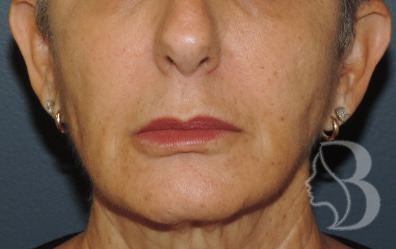
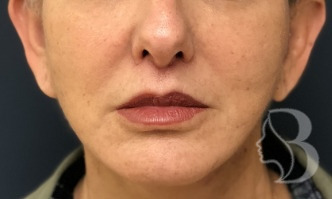
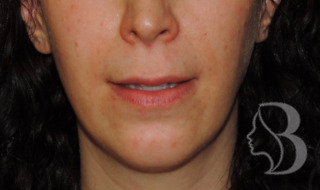
The single most important question is: Is your philtrum too long, or is your lip simply too thin? A long philtrum requires a lip lift. A thin but well-positioned lip responds well to filler. These are not interchangeable treatments.
Dr. Rafizadeh performs lip lifts and advises on this comparison for patients from across North Jersey — Morristown, Summit, Chatham, Short Hills, Livingston, Madison, Millburn, Westfield, and Ridgewood — as well as from Manhattan, Brooklyn, Hoboken, Jersey City, and other parts of the NYC tri-state area. Morristown is approximately 40–45 minutes from Midtown Manhattan, making it a practical destination for NYC-area patients seeking a surgeon who specializes in the lip lift.
“When I see a patient who has been adding filler for years and still isn't satisfied, the answer is usually that their philtrum is long. No amount of filler shortens the philtrum. You can make the lip bigger, but you can't make it higher — that requires surgery.”
— Dr. Farhad Rafizadeh MD FACS
Side-by-Side Comparison
| Factor | Lip Lift (Surgical) | Lip Filler (Injectable) |
|---|---|---|
| What It Corrects | Long philtrum, rolled-in upper lip, reduced tooth show, downturned corners | Thin lip body; loss of volume; mild definition |
| Mechanism | Removes skin to structurally elevate and evert the lip | Adds hyaluronic acid volume to expand lip tissue |
| Duration | Permanent | 6–18 months (varies by product & metabolism) |
| Downtime | 5–7 days | 1–3 days (swelling/bruising) |
| Anesthesia | Local with optional IV sedation | Topical numbing cream only |
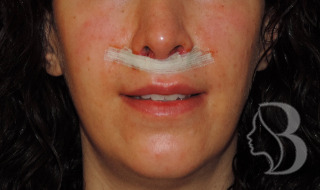
| Scar | Yes — hidden in nasal sill; typically imperceptible at 6–12 months | None |
| Reversal | Not reversible | Reversible with hyaluronidase |
| Long-term Risks | Scar visibility, asymmetry (rare with experienced surgeon) | Migration, granuloma formation, tissue changes with repeat injections |
| Cost over 5 Years | $3,500–$5,500 once | ~$800–$1,500/yr × 5 = $4,000–$7,500 |
| Best Candidate | Philtrum >14 mm; dissatisfied with repeated filler; wants permanent result | Thin lip with normal philtrum; wants reversible, low-commitment option |
How to Know Which You Need
Measure your philtrum — the vertical distance from the base of your nose to the top of your upper lip — with a ruler while your face is relaxed. If it exceeds 14 mm (women) or 16 mm (men), you are a strong candidate for a lip lift regardless of whether your lips appear thin. If your philtrum is in a normal range but your lips feel lacking in fullness, filler is the more appropriate starting point.
Another telling sign: if you have been adding filler repeatedly and still feel the result looks "heavy" or "ducky" rather than elevated and defined, that is characteristic of filler being used to compensate for a structural problem it cannot solve. More filler will add projection without elevation — which is why the result feels wrong.
You may be a surgical candidate
- Your philtrum is longer than 13–14 mm
- Upper teeth barely show at rest
- Filler made your lip bigger but not higher
- You want a permanent solution
- You're tired of maintenance injections
- You want a more defined cupid's bow
You may prefer a non-surgical approach
- Your philtrum is under 13 mm
- You want more volume, not more height
- You prefer a reversible option
- You want to try before committing to surgery
- You are happy with your lip position
- You are not ready for downtime or a scar
The "Filler Fatigue" Phenomenon
A growing number of patients are what practitioners call "filler fatigued" — they've been getting regular lip injections for years, their total volume has grown substantially, and yet they are still not satisfied. The reason is clear: filler adds volume in three dimensions (forward, sideways, and upward), but a lip lift provides the one correction filler cannot — superior repositioning of the lip relative to the nose. For these patients, allowing the accumulated filler to dissolve and then having a lip lift often produces a dramatically more natural result than continuing to build volume.
Combining Lip Lift and Filler
Lip lift and filler are not mutually exclusive. The most natural combination approach: have the subnasal lip lift first to correct the structural philtrum length, allow 3–6 months for full healing, then add a small amount of filler or fat grafting if additional body volume is desired. The combination typically produces a result that is more refined and natural than either approach alone, because the structural foundation is correct before volume is added.
Cost Over Time: Lift vs. Filler
For many patients the deciding factor is lifetime cost, not the price of a single treatment. A subnasal lip lift at Dr. Rafizadeh's Morristown, NJ practice typically ranges from $3,500 to $5,500 as a one-time fee — the structural result is permanent. Lip filler in the New Jersey and New York City market generally runs $600 to $1,200 per syringe and is reabsorbed over roughly 6 to 12 months, so maintaining the look means repeating the expense indefinitely. Over five to ten years of regular injections, the cumulative cost of filler commonly exceeds the one-time cost of a lift, which is part of why so many long-term filler patients ultimately choose surgery.
There is also a geographic cost advantage. Patients who travel the ~40–45 minutes from Manhattan, Brooklyn, or Westchester to Morristown frequently find that fees for the same elective lip surgery are meaningfully lower than at comparable Manhattan practices — without compromising on a board-certified surgeon who sub-specializes in the lip lift. An itemized quote is provided at consultation; because both treatments are cosmetic, insurance does not apply to either.
Related Reading from Our Blog
Still deciding between a lift and filler? Dr. Rafizadeh works through the same questions with New Jersey and NYC-area patients on the blog:
→ My Lip Filler Keeps Migrating — Could I Need a Lip Lift Instead?The migration and “filler fatigue” problem explained — and why a structural lift often solves what more filler cannot. → Lip Lift Surgery in NJ: What You Need to KnowA plain-language overview of the procedure, candidacy, and recovery for patients weighing a permanent lift against repeat injections. → Should You Get a Lip Lift Now or Wait for a Facelift?Timing and sequencing a lip lift with future facial surgery — useful context if you are planning your lip rejuvenation around aging. → Why Botox & Filler Don’t Erase Deep Upper-Lip LinesWhere injectables reach their limit on the upper lip — and when resurfacing or a structural lift is the honest answer instead.