When earlobes need help
Earlobes are deceptively delicate. Years of heavy earrings, a single accidental tug, or the intentional stretching of gauge jewelry can leave earlobes torn, elongated, or structurally compromised. The good news: earlobe repair is one of the most straightforward procedures in plastic surgery — typically performed in under an hour under local anesthesia, with little downtime and very natural results.
Dr. Rafizadeh has performed hundreds of earlobe repairs across every presentation — from the partial tear caused by a caught earring to the complete through-and-through split requiring careful tissue reapproximation, to the large-gauge plugged hole requiring staged or single-session reconstruction. Each is corrected using precise plastic surgery technique to minimize visible scarring and restore normal anatomy.
Gauge Repair Before & After
View Full Gallery →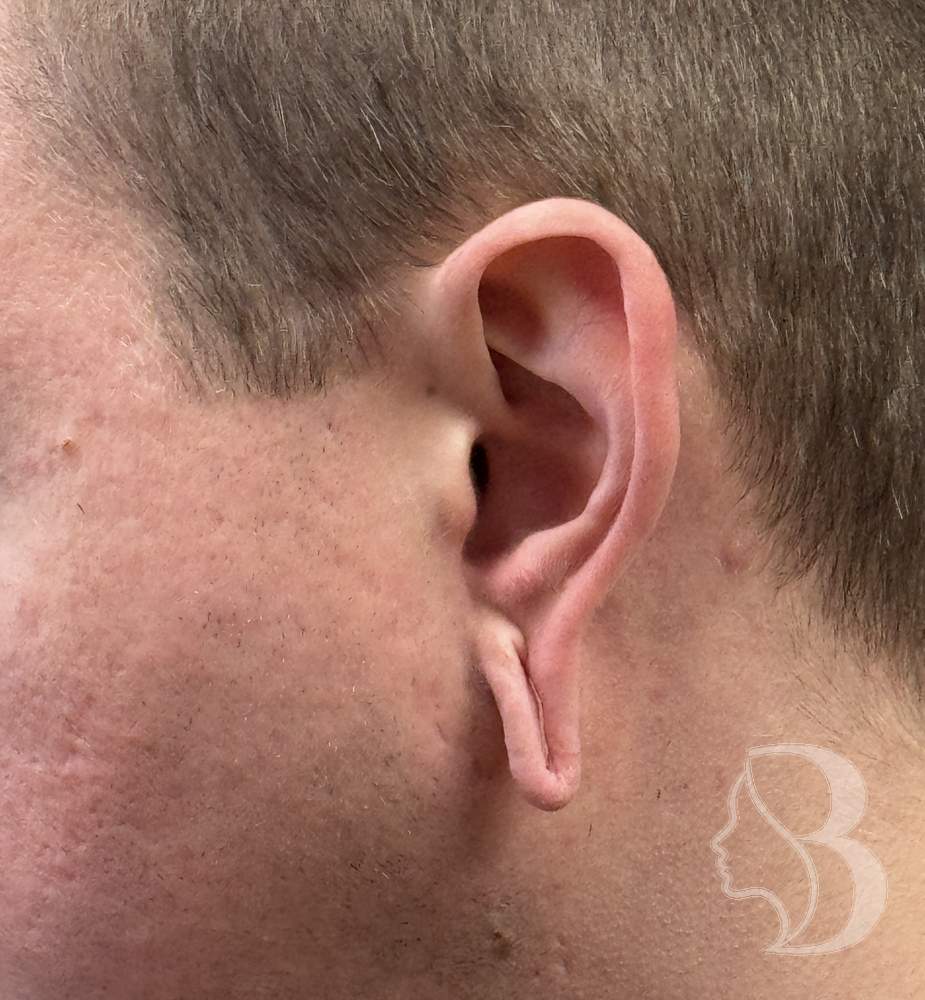
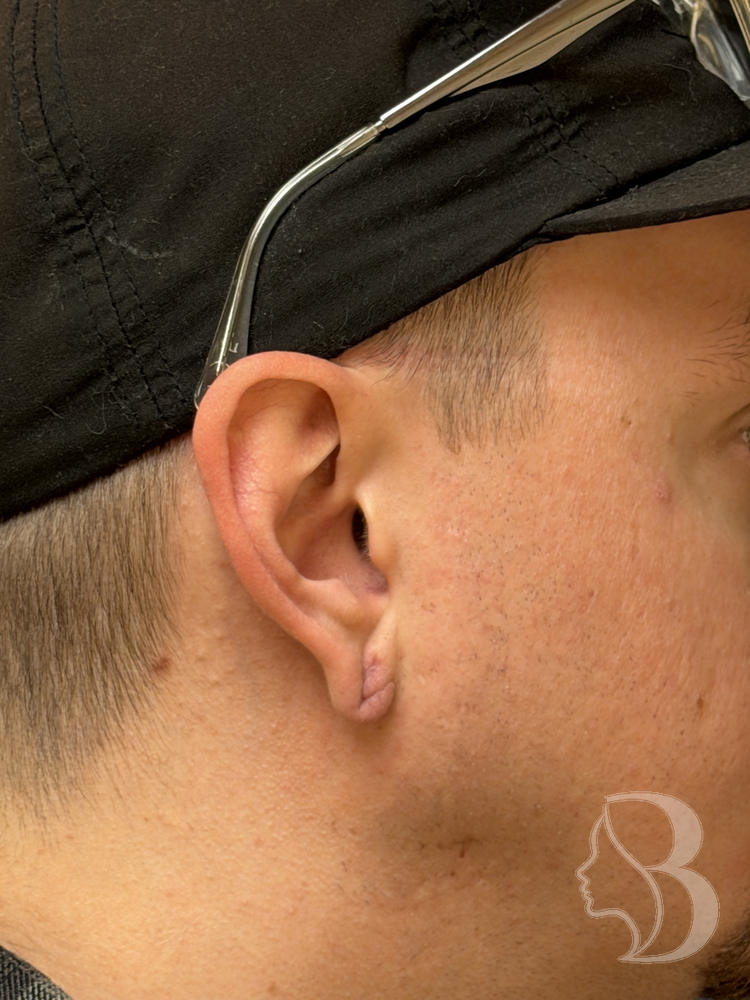
Types of earlobe damage
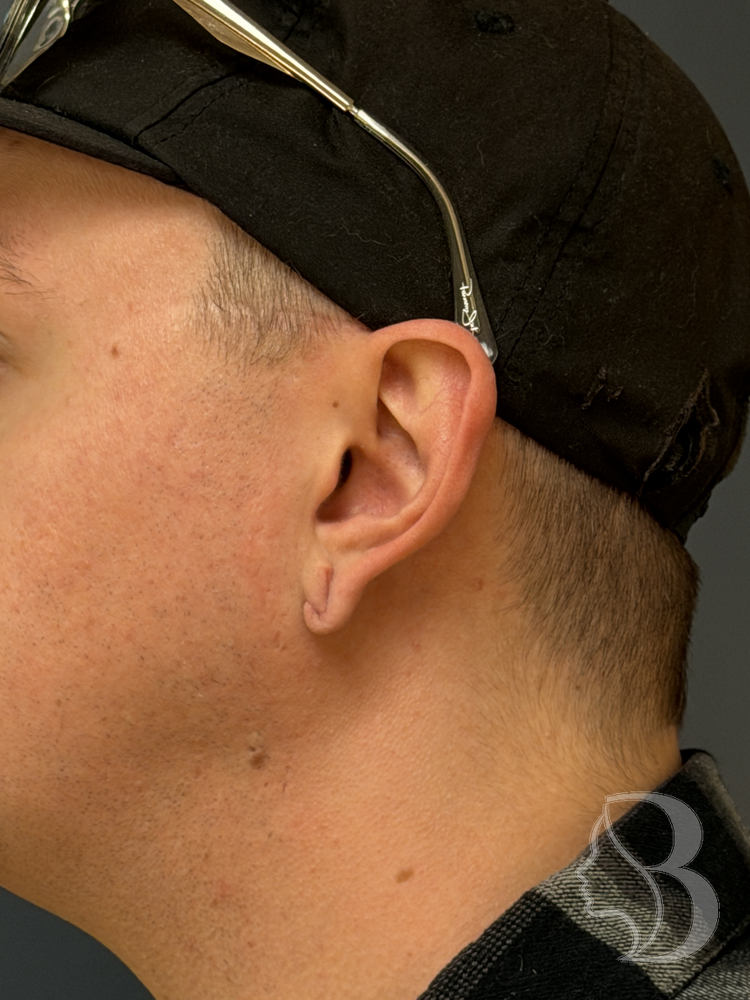
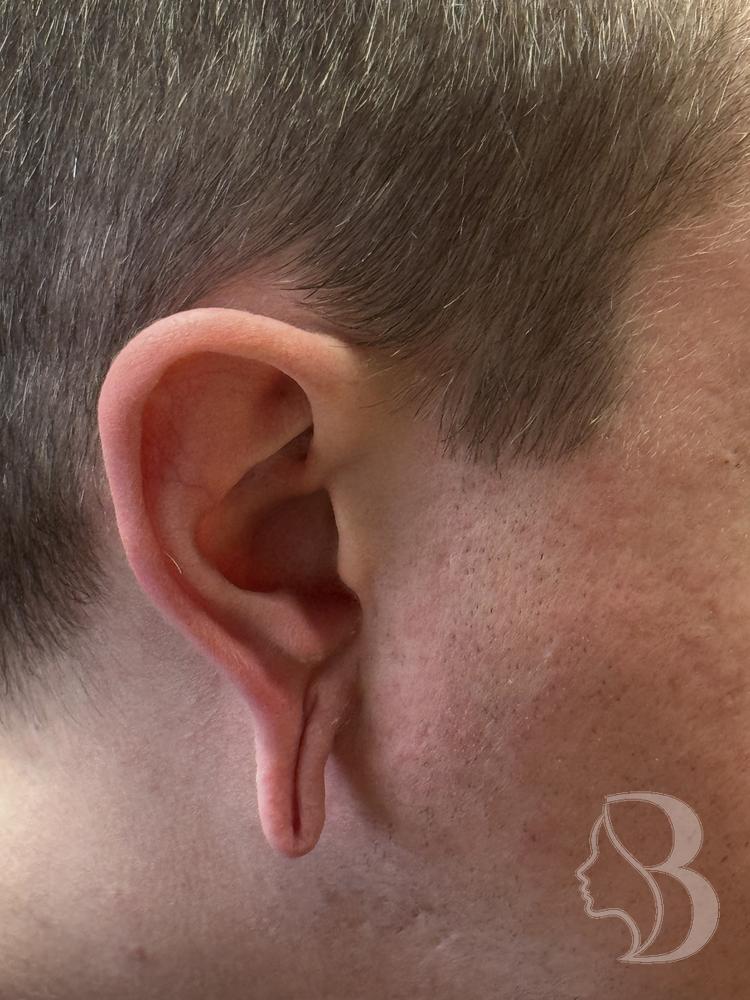
Not all earlobe problems are the same. Understanding the type of damage guides the appropriate repair technique:
Partial tears occur when an earring is pulled partway through the lobule, leaving a notch or elongated hole that hasn't fully split. These are the most common presentation and are often repaired with a simple excision and layered closure.
Complete splits (bifid earlobes) result from a full through-and-through tear. The lobule has two distinct flaps of skin that must be freshened and reapproximated in layers — simply suturing the raw edges together would result in a notched, unnatural contour. Dr. Rafizadeh uses a Z-plasty or flap technique to break up the scar line and restore a rounded lobule edge.
Stretched or elongated piercings develop gradually from years of heavy earrings. The hole doesn't fully split, but it migrates inferiorly and the tissue thins. Repair involves excising the stretched tract and closing the defect in layers.
Gauge (plug) repairs are the most complex earlobe corrections. Tissue expanders — called plugs or gauges — progressively stretch the lobule to diameters of 10mm, 20mm, or larger. Smaller gauges (under 10–12mm) often close spontaneously over months after removal. Larger defects require surgical excision of the stretched skin and reconstruction of the lobule — sometimes in a single session, sometimes in staged procedures depending on the degree of stretching and available tissue.
Repair techniques compared
| Injury Type | Technique | Scar Placement | Re-Piercing |
|---|---|---|---|
| Partial tear / elongated hole | Simple excision & layered closure | Within existing piercing track | 6–8 weeks post-op |
| Complete split (bifid lobe) | Z-plasty or flap closure | Broken scar line across lobule edge | 6–8 weeks post-op |
| Stretched / heavy-earring migration | Tract excision, layered closure | Inferior lobule, within skin fold | 6–8 weeks post-op |
| Small gauge (<10 mm) | Excision & primary closure | Central lobule, fades with time | 8–12 weeks post-op |
| Large gauge (>10 mm) | Staged reconstruction / local flap | Lobule perimeter | 3–6 months post-op |
What to expect on the day of surgery
Earlobe repair is performed in Dr. Rafizadeh's office procedure suite and typically takes 30 to 60 minutes per ear. No sedation is required — a small amount of local anesthetic is injected to numb the earlobe completely before work begins.
The key principle in earlobe repair is that raw skin edges must never simply be sutured together — doing so creates a notched, contracted result. Instead, Dr. Rafizadeh freshens the wound edges by excising a thin rim of epithelialized skin along the tear track, which creates a clean tissue surface that heals without the indentation and contracture that defines a poor repair. Closure is performed in two layers: a deep suture for the dermis and a fine superficial suture for the skin. The result is a smooth, rounded lobule contour.
For gauge repairs, additional tissue rearrangement is often needed. Dr. Rafizadeh may use a local advancement flap or V-Y technique to recruit adjacent tissue and reconstruct the lobule shape without excessive tension on the closure.
"The difference between a good earlobe repair and a poor one comes down to a single principle — you must excise the epithelialized edges before closing. Skip that step and the scar contracts into a notch."
Dr. Farhad Rafizadeh MD FACSRecovery & re-piercing
Recovery from earlobe repair is minimal. Sutures are typically removed at 7 days, after which most patients feel comfortable returning to normal activities. The repaired earlobe is tender and slightly swollen for the first week; sleeping on the ear should be avoided during this period.
Scar maturation takes 6 to 12 months. In the early weeks the scar may appear pink or slightly raised — this is expected and resolves with time. Silicone gel sheeting or a small amount of scar cream can be applied once the wound is fully closed.
Re-piercing is generally safe at 6 to 8 weeks after standard repairs, and 3 to 6 months after larger gauge reconstructions. It is important to pierce slightly above the original site — not directly through the repair — to avoid placing stress on the healed tissue.
Are you a good candidate?
Nearly anyone with a torn, split, stretched, or gauged earlobe is a candidate for repair. The procedure is appropriate for men and women of all ages, including teenagers (with parental consent). There is no minimum or maximum age requirement. The main considerations are:
Active infection or inflammation: The repair should be delayed until any active piercing infection is fully resolved. Keloid-prone individuals should discuss their history with Dr. Rafizadeh, as earlobes are a common site for keloid formation — though the risk is lower than with other types of ear surgery.
Large gauge repairs: Patients with very large gauge piercings should be aware that achieving a lobule size identical to their pre-piercing anatomy is not always possible. Dr. Rafizadeh will review realistic expectations at the consultation and can show representative results.
Cost in New Jersey
Earlobe repair typically ranges from $800 to $2,500 per ear depending on the complexity of the repair. Simple partial tears or elongated piercings are on the lower end; complete splits and small-gauge repairs fall in the mid-range; large-gauge reconstructions requiring flap work are at the upper end. The fee includes the procedure, local anesthesia, and follow-up visits. A precise quote is provided at consultation after Dr. Rafizadeh has assessed the injury in person.
To learn more about Dr. Rafizadeh's philosophy on ear surgery and natural-looking results, read his article on precision otoplasty and ear pinning for natural results in New Jersey.
Earlobe repair is considered cosmetic and is not covered by insurance. Financing options are available through CareCredit and Alphaeon Credit.