
Among the more than 1,500 patient questions Dr. Farhad Rafizadeh has answered on RealSelf, a recurring theme surfaces from patients who loved their first facelift: can they expect equally good results from a second one? One patient from Austin, Texas put it this way after being told by friends to “adjust her expectations”:
“Is it true that a 2nd face lift will never give the same results as a first face lift? Due to a lot of sun damage, I am considering a 2nd face lift ~7 years from my first. I LOVED my first face lift but a few people told me that I need to adjust my expectations for a 2nd.”
It is the kind of question that arrives from a place of genuine concern — often mixed with a little hope. The patient had a wonderful result the first time. They are not ready to accept that the second chapter has to be worse. And in the hands of the right surgeon, it does not have to be.
Dr. Rafizadeh’s Answer: 40+ Years of Secondary Facelifts
When I perform a facelift, I always assume that the procedure will have to be redone in 7 to 10 years. Having been in active private practice for 38 years, I have done many secondary facelifts on patients that I had operated upon or on patients who came to me having had their first or second facelift elsewhere. There are patients on whom I have performed three facelifts over a span of 30 years. The results have always been good.
That is not a reassuring platitude. That is a statement grounded in decades of clinical experience performing secondary and tertiary facelifts at his Morristown, NJ practice — on patients who arrived from across Northern New Jersey, from Manhattan, and from around the country.
The core of his answer: secondary facelifts succeed when the surgeon recognizes the problems and solves them one by one — and when the surgeon looks at the whole face, not just the original operative area.
Why a Second Facelift Is Not Simply a Repeat of the First
This is the nuance that most patients — and some surgeons — miss. A second facelift is not pulling the same levers twice. The face continues to age after the first procedure: fat redistributes, skin changes texture, bone remodels, and structures that were not addressed the first time become relevant. Dr. Rafizadeh explains:
It is always about recognizing the problems and solving them one by one. It is also about looking at the other areas of the face and determining what needs to be done in order to keep the balance and harmony of the face and produce a natural result.
In practice, this means a secondary facelift consultation involves a complete reassessment of every facial zone — not just the lower face and neck that were treated originally. Several areas that commonly require attention in a second procedure:
- The brow: Brow descent accelerates with age and is frequently the most important overlooked contributor to a “tired” look. A secondary facelift is often the right moment to add an endoscopic brow lift for the first time.
- The eyes: Upper and lower eyelid surgery (blepharoplasty) addresses hooding and lower-lid bags that accumulate independently of jowling and neck laxity. It is one of the most common additions to a secondary facelift plan.
- The upper lip: As Dr. Rafizadeh has noted in many of his answers, the philtrum (the distance between the nose and the top of the lip) lengthens with age. A lip lift is often the right addition in a secondary facelift — even for patients who never needed one after the first procedure.
- Volume: Faces deflate with age. Fat grafting to the cheeks, temples, and under-eye hollows is frequently appropriate alongside a secondary lift, producing a more balanced, youthful result.
A surgeon who simply redo the original incisions and tightens the same tissues without addressing these evolving issues is setting up a mediocre result. An experienced surgeon plans the whole face.
What the Medical Literature Says
Dr. Rafizadeh’s clinical experience aligns with what the peer-reviewed literature shows. A study published in the Aesthetic Surgery Journal and reported by the American Society of Plastic Surgeons found that secondary facelifts, performed an average of a decade after the initial procedure, achieve similarly lasting results — with a complication rate of approximately 5%, nearly identical to that of first-time facelifts. Patients’ satisfaction levels were high.
A 2020 review in Plastic and Reconstructive Surgery Global Open examining common challenges in facelift revision reached a similar conclusion: secondary facelifts are achievable and satisfying, provided the surgeon identifies the specific deficiencies of the previous result and plans the revision accordingly.
The headline takeaway: a blanket statement that “a second facelift will never be as good” is not supported by the evidence. What is supported is that secondary facelifts require more experience, more planning, and a more comprehensive view of the face than primary procedures. In the right hands, the results are excellent.
How Long Should You Wait Between Facelifts?
Most Northern New Jersey patients who seek a second facelift do so 7 to 15 years after their first. This aligns with what Dr. Rafizadeh builds into his planning from the start: he designs every facelift with the expectation of a secondary procedure in that window, selecting incision placements and tissue handling techniques that make any future revision as technically clean as possible.
In terms of absolute minimum wait time, most surgeons recommend at least 12 months after the first facelift before considering a revision — allowing full tissue softening, scar maturation, and a clear-eyed assessment of the settled result. For patients unhappy with an outcome, it is almost always worth waiting the full year before re-operating.
The Technical Challenges of a Secondary Facelift
Honesty requires acknowledging that secondary facelifts are more technically demanding. The reasons:
- Scar tissue: Prior incisions create adhesions in the subcutaneous plane that must be carefully released without damaging underlying nerves or vascular supply.
- Skin quality: The skin has been undermined and redistributed once; it must be handled with more care the second time to avoid circulation problems at wound edges.
- SMAS mobility: If the SMAS was already plicated or imbricated in the first operation, the available tissue for repositioning is reduced. The surgeon may need to go deeper or use different techniques to achieve the same lift.
- Modified approach: As Dr. Rafizadeh notes, “I often modify my second facelift approach depending on the patient’s requirements.” Rigid adherence to a single technique across all patients — primary and secondary alike — is a red flag.
These technical demands are precisely why the choice of surgeon matters more, not less, for a secondary facelift. Experience with revision surgery, a deep understanding of the anatomy after prior dissection, and the flexibility to modify the approach are all non-negotiable.
What to Look for in a North Jersey Surgeon for a Secondary Facelift
If you are considering a second facelift and you are researching surgeons in Morristown, Summit, Chatham, Short Hills, Madison, Bernardsville, or anywhere in Northern New Jersey, the conversation with your surgeon should cover several specific points:
- How many secondary facelifts do they perform per year, and can they show you before and after results from revision patients (not just primary cases)?
- Will they review the results of your first facelift and identify what specifically was done and what was left untreated?
- Do they assess the full face — brow, eyes, lip, volume — or only the original operative zones?
- What technique modifications will they make for a secondary case compared to a primary procedure?
- Will the procedure be performed under local anesthesia with moderate sedation, as is appropriate for most facial procedures?
A surgeon who has performed three facelifts on the same patient over 30 years, as Dr. Rafizadeh has, has a fundamentally different relationship with revision surgery than one who has only performed it a handful of times. The body of work matters.
Patient Before & After
View Full Gallery →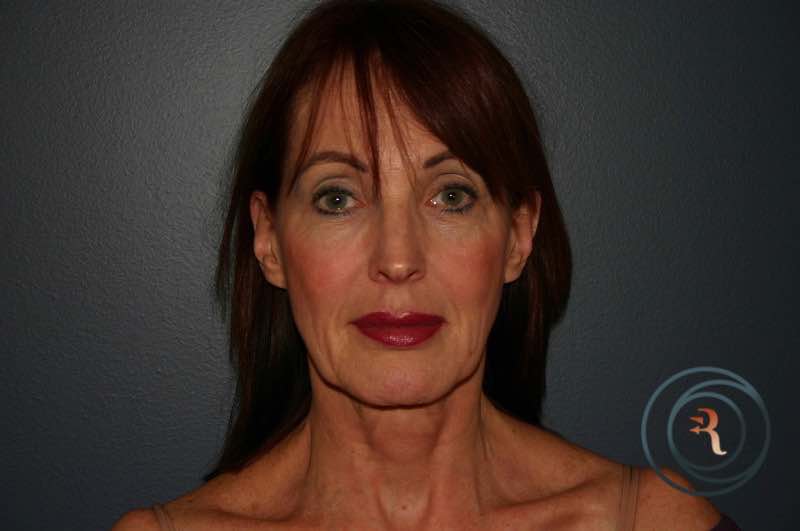


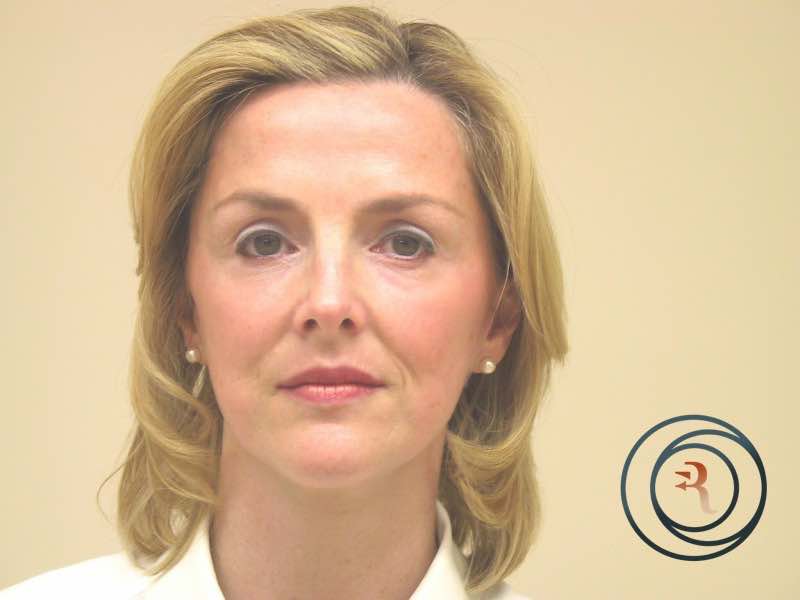
Both cases above demonstrate the natural, balanced result Dr. Rafizadeh designs for — the same standard he applies to secondary and tertiary facelifts as to primary procedures.
Questions Patients Should Ask Before a Second Facelift in North Jersey
A secondary facelift consultation is different from a first. You are not starting from zero — you have an existing result, an existing scar pattern, and an existing history that informs what should happen next. Come prepared with:
- Your original operative report from the first facelift, if available (request it from the surgeon or hospital)
- Before-and-after photos from your first procedure
- A clear description of which aspects of your current appearance bother you most — jowling, neck laxity, hollowness, brow descent, eyelid changes, lip area?
- Any photos of how you looked at your best result from the first facelift, for reference
- A realistic sense of your timeline and what you are trying to achieve (a modest refresh vs. a significant structural restoration)
The more information you bring to the consultation, the more precisely your surgeon can plan. Dr. Rafizadeh uses this information to design a comprehensive, individualized plan — one that addresses not just the areas treated before, but the full picture of how your face has aged since the first procedure.
Common Questions About Second Facelifts in North Jersey
Is a second facelift worth it?
For most patients, yes — a second facelift is absolutely worth it. Research published by the American Society of Plastic Surgeons confirms that secondary facelifts achieve similarly lasting results with a complication rate nearly identical to primary procedures. Dr. Rafizadeh has performed secondary and even tertiary facelifts over his 40+ year career in Morristown and consistently finds excellent outcomes when the surgeon approaches the procedure with a fresh, comprehensive view of the whole face.
Is it safe to have a second facelift?
Yes, a second facelift is safe when performed by an experienced, board-certified plastic surgeon. The complication rate for secondary facelifts is very close to that of first-time procedures. The surgery is more technically demanding due to existing scar tissue, but a skilled surgeon anticipates these challenges. For patients in good general health in Northern New Jersey, there is no significant added medical risk compared to the initial procedure.
How long does a second facelift last compared to the first?
A first facelift typically lasts 10 to 15 years. A secondary facelift generally produces results lasting 7 to 10 years. Dr. Rafizadeh always plans a facelift with the expectation it may need refreshing in 7 to 10 years — which is why he structures the first operation to make any future revision as technically clean as possible. Both the first and second facelift longevities depend heavily on sun protection, weight stability, and genetics.
Should a 70-year-old get a facelift?
Age alone is not a disqualifying factor. Dr. Rafizadeh has operated on patients in their 70s and 80s in Morristown with excellent results. The key factors are overall health, realistic expectations, and choosing a surgeon who performs the procedure under local anesthesia with moderate sedation rather than general anesthesia — which meaningfully reduces the anesthetic burden and recovery difficulty in older patients.
What is the average cost of a facelift in New Jersey?
Facelift costs in New Jersey typically range from $10,000 to $25,000 depending on the technique, whether neck lift is included, and whether additional procedures like eyelid surgery or fat grafting are added. Secondary facelift pricing is often in a similar range. Dr. Rafizadeh charges a $100 consultation fee, which is waived when you book a procedure — a personalized estimate is only possible after an in-person assessment in Morristown.
What causes a “Joker smile” after a facelift?
A “Joker smile” — an unnaturally wide, upward-pulled mouth — results from excessive tension placed on the superficial skin rather than repositioning the deeper SMAS layer and fat compartments. Dr. Rafizadeh works in the deeper tissue planes, redraping the SMAS and fat rather than over-pulling the skin. Patients who developed this distortion after a first facelift can often be significantly improved in a secondary procedure that corrects the underlying tension and restores natural movement.
When is the right time to consider a second facelift?
Most patients seek a second facelift 7 to 15 years after their first, when jowling, neck laxity, or facial volume changes return. Dr. Rafizadeh recommends consulting sooner rather than waiting until changes become severe — it is easier to maintain a result than to rebuild from significant aging. A consultation at his Morristown, NJ office can help you determine whether a second facelift is the right next step or whether non-surgical maintenance such as fillers or radiofrequency would serve you better in the near term.
Sources & References
- Skouras G, Sherris D, Hilger PA. “Revision and Secondary Facelift: Problems Frequently Encountered and Their Solutions.” Plastic and Reconstructive Surgery Global Open. 2020;8(8):e3036. PubMed Central
- American Society of Plastic Surgeons. “Secondary Facelift Achieves Good Results, Reports Plastic Surgeon.” Press release, Feb. 28, 2013. plasticsurgery.org
- Dr. Farhad Rafizadeh. RealSelf Q&A: “What to expect from a second facelift. Will my results be as good as my first? 7 years post op.” Answered Oct 7, 2022. realself.com
- American Board of Plastic Surgery. Verification of Board Certification. abplasticsurgery.org
- Cleveland Clinic. “How Long Does a Facelift Last and Other FAQs.” Cleveland Clinic Health Essentials. Jan. 31, 2024. clevelandclinic.org
Related Reading From Dr. Rafizadeh’s Blog
- Facelift Recovery: How Long Does Swelling and Asymmetry Last?
- Neck Lift With a Facelift: Do You Need Both?
- Safest Anesthesia for Older Facelift Patients
- Deep Plane Facelift in NJ — Dr. Rafizadeh’s Approach
- How to Make a Facelift Effective With a Quick Recovery in New Jersey
- What Is the Price of a Facelift?
Bottom Line
The idea that a second facelift must produce inferior results is a myth — one that is contradicted by decades of surgical experience and by the peer-reviewed literature. What is true is that secondary facelifts require more from the surgeon: more experience with revision anatomy, more willingness to modify the approach, and more commitment to viewing the whole face as it has aged since the first procedure.
Dr. Rafizadeh has performed secondary and tertiary facelifts throughout his 40+ year career in Morristown, and his approach is built on the same principle that governs the first procedure: recognize what the patient actually needs, solve it specifically, and design the result to look natural — not operated.
If you are considering a second facelift and you are based in Morristown, Summit, Chatham, Short Hills, Madison, Bernardsville, Mendham, Florham Park, or anywhere in Northern New Jersey, a consultation at Dr. Rafizadeh’s Morristown office is the right starting point. Out-of-town patients from Manhattan, Westchester, or beyond can learn more about making the visit work on the out-of-town patient page.
Considering a second facelift? Schedule a consultation in Morristown, NJ.
Book a Consultation