
One of the most common questions Dr. Farhad Rafizadeh receives in his Morristown consultation room — and a recurring theme on his RealSelf Q&A page — comes from women researching a tummy tuck who have stumbled across a less familiar word: puboplasty, or monsplasty, or mons pubis lift.
“Why would I need a puboplasty with a tummy tuck? What IS puboplasty exactly, and would it leave me with another scar?”
It is the right question to ask, because for many women in Northern New Jersey planning a tummy tuck — especially after pregnancy or weight loss — the mons pubis is the area that quietly decides whether the final result looks balanced or whether the pubic area suddenly looks more prominent than it did before surgery.
The short version of the answer: a monsplasty (also called a puboplasty, mons pubis lift, or pubic lift) is a procedure that thins and lifts the soft tissue mound directly above the pubic bone. When it is added to a tummy tuck, it uses the same bikini-line incision — so there is no extra scar. And in the right candidate, it’s often the difference between a good tummy tuck result and a great one.
Dr. Rafizadeh’s Short Answer
The mons pubis is part of the lower abdomen, not separate from it. After we flatten the abdomen and tighten the skin during a tummy tuck, an untreated mons can look puffier and more prominent than it did before — not because anything changed in the mons, but because the contrast above it changed. When the anatomy calls for it, I do the monsplasty through the same incision, in the same operation. It adds maybe 30 to 45 minutes, no separate scar, and the recovery is essentially the same as a tummy tuck alone.
That answer captures the practical reality. The monsplasty is not a separate operation in the sense of a separate day, a separate anesthesia, or a separate scar. It is an additional step performed through the existing tummy tuck incision during the same procedure. The question for any North Jersey patient considering a tummy tuck is not whether the mons should be evaluated — it should be, every time — but whether it needs to be directly treated.
What Exactly Is the Mons Pubis?
The mons pubis is the soft, padded mound of skin and fat that sits over the pubic bone, between the lower abdomen and the genital area. Anatomically, it is part of the same skin envelope as the lower abdomen — the connective tissue and fat layers are continuous — but it has its own distinct shape, projection, and skin character.
Two things make the mons unusually responsive (in both directions) to pregnancy, weight gain, and weight loss:
- It carries a higher fat density than most other body regions. The mons is a natural fat reservoir in women, anatomically — one of the body's preferred storage areas in early adulthood and after pregnancy.
- It hangs from the upper edge. The mons is supported by the suspensory ligaments and the integrity of the overlying skin. When pregnancy stretches that skin, or when weight loss leaves it loose, the mons doesn't snap back the way other body regions sometimes do. It droops down and forward.
When patients ask Dr. Rafizadeh about the post-Ozempic body or the post-pregnancy body in particular, the mons is one of the regions that often arrives in the consultation room looking saggier than the patient remembered it being.
Why a Tummy Tuck Alone Often Doesn’t Solve the Mons
A standard tummy tuck (abdominoplasty) does three things, in roughly this order:
- Removes a horizontal strip of skin and fat from the lower abdomen, just above the pubic bone.
- Repairs separated abdominal muscles (the rectus diastasis) from the rib cage to the pubic bone.
- Redrapes the upper abdominal skin downward to create a smooth, flat surface, with the belly button repositioned through a new opening in the skin.
All of that work happens above the pubic bone. The mons itself — the tissue directly over and below the upper edge of the pubic bone — is technically pulled slightly upward as the abdominal skin is redraped, but it isn’t directly thinned, sculpted, or lifted. If it was fatty or sagging going into the operation, it’s still fatty or sagging coming out.
And here is the visual problem: once the abdomen above is suddenly flat, any residual fullness or laxity at the mons looks more prominent than it did before. Patients sometimes describe it as “I love my new stomach, but the area below it looks bigger now.” The area didn’t get bigger. The contrast did.
This is the single most common reason a thoughtfully planned monsplasty is added to a tummy tuck during the original consultation in Dr. Rafizadeh’s Morristown office.
What a Monsplasty Actually Does
A monsplasty performed during a tummy tuck typically addresses three components:
1. Thinning the Mons (Liposuction)
If the mons is fatty, Dr. Rafizadeh uses tumescent liposuction to thin the subcutaneous fat in the pubic mound, matching the new thickness of the adjacent lower abdomen. This step is what makes the lower abdomen and pubic area look like one balanced contour rather than two separate planes.
2. Removing Excess Mons Skin
The horizontal tummy tuck incision is the upper border of the mons. When there is excess skin in the mons itself — sagging downward or forward — the surgeon trims an appropriate amount from the upper edge of the mons as part of the same closure. No additional incision is created.
3. Anchoring the Mons in a Higher Position
When laxity is significant, deep anchoring sutures are placed from the deep mons tissue (the underlying fascia) to fixed points on the lower abdominal wall. This holds the mons in a higher, flatter position so it doesn’t simply drift back down over time. This is the structural difference between “the mons looks better for a year” and “the mons looks better in a decade.”
The combination of these three components — thinning, skin removal, and anchoring — is what distinguishes a formal monsplasty from a tummy tuck’s incidental mons elevation.
Will There Be an Extra Scar?
No. This is the part patients are most relieved to learn. When the monsplasty is performed at the same time as the tummy tuck, the entire procedure shares the same low, horizontal bikini-line incision — the one designed to hide inside underwear and swimwear. The mons is reshaped from inside, and the same closure that finishes the tummy tuck finishes the mons.
The patients who end up with additional scarring are usually those who have a monsplasty as a separate operation years after a tummy tuck — because the mons wasn’t addressed at the original surgery, and the patient discovered the result looked unbalanced months later. That second-surgery scenario is exactly what a thorough initial consultation in Morristown is designed to prevent.
Dr. Rafizadeh has performed abdominoplasty in Morristown for over 40 years. See techniques, candidacy, recovery, and real before-and-after results.
Explore Tummy Tuck Surgery or call (973) 267-0928Who Is the Right Candidate for a Tummy Tuck + Monsplasty?
Not every tummy tuck patient needs a monsplasty. The honest answer is that the mons should be evaluated in every tummy tuck consultation, and the monsplasty should be added when:
- The mons carries visible excess fat — the so-called “FUPA” (fatty upper pubic area).
- The mons has loose, hanging, or stretched skin from pregnancy, weight loss, or aging.
- The mons projects significantly forward when the patient stands, creating a bulge that would still be visible after the abdomen is flattened.
- The patient is bothered by the mons specifically — sometimes because of how it looks in clothing, sometimes because of chafing, hygiene, or sexual comfort concerns that go along with significant mons overhang.
If the mons is naturally well-shaped going into the operation, no monsplasty is needed — the tummy tuck’s incidental elevation is enough. If any of the conditions above are present, a planned monsplasty during the same operation is the conservative, predictable solution.
What Recovery Actually Looks Like in Morristown
For a healthy candidate in Northern New Jersey having a tummy tuck plus monsplasty, the recovery timeline at Dr. Rafizadeh’s Morristown practice looks essentially identical to a tummy tuck alone:
Day of Surgery
The procedure is performed in an accredited outpatient surgical facility, typically under local anesthesia with moderate sedation or general anesthesia depending on the case and patient preference. Most patients are walking the same evening, wearing a compression garment, and sleeping in a slightly flexed position to take tension off the closure.
First Week
Compression garment use is continuous except for showering. The mons is dependent — meaning gravity collects fluid there — so it can look puffy for the first one to two weeks. This swelling is normal and self-resolving. The patient is encouraged to walk short distances starting the first evening to support circulation.
Weeks 2–6
Most North Jersey patients are back to office work by 10 to 14 days. Compression continues. Light walking expands to longer walks. Sleeping position relaxes gradually. The TAP block technique Dr. Rafizadeh uses for postoperative pain control means most patients are off prescription pain medication within several days.
Months 3–6
The mons typically takes a little longer to fully settle than the surrounding abdomen, because it is the dependent area and the last to finish lymphatic remodeling. By three months the contour is essentially what it will be long-term. By six months the result is final. The horizontal scar is fading from pink to a thin, pale, well-hidden line at the bikini band.
What This Looks Like in Real Patients
Patients are often surprised that the addition of a monsplasty — a step that takes 30 to 45 extra minutes during the same operation — has such a disproportionate impact on the final look of the lower abdomen. The cases below were each performed by Dr. Rafizadeh in Morristown and represent the kind of balanced, naturally proportioned lower-abdominal contour a properly planned tummy tuck delivers in a North Jersey patient.
Patient Before & After
View Full Gallery →
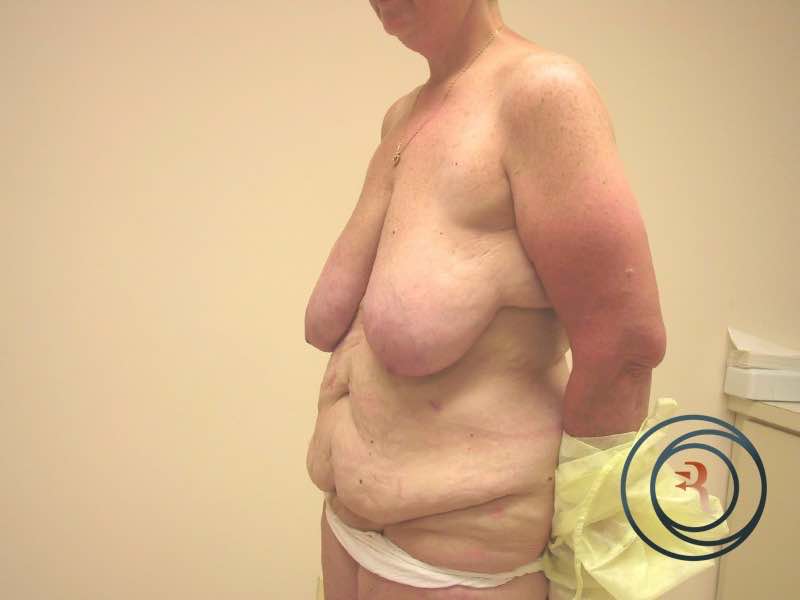
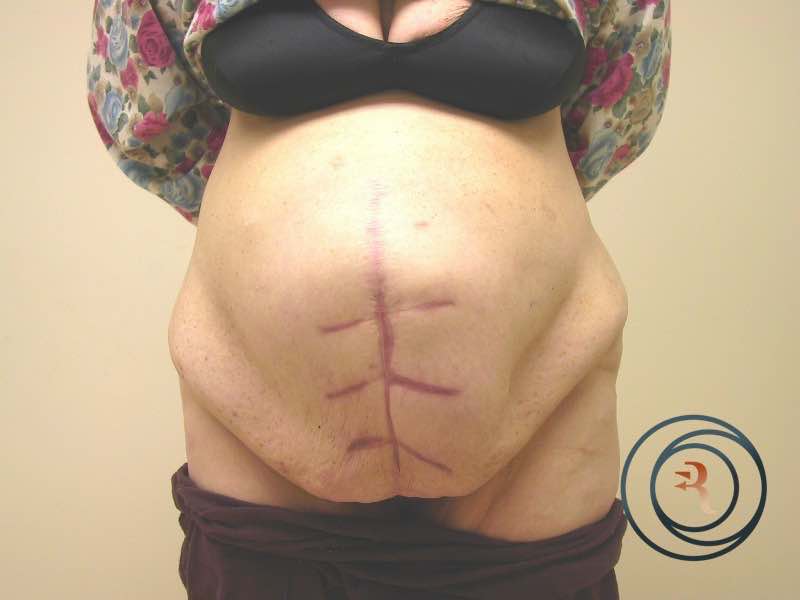
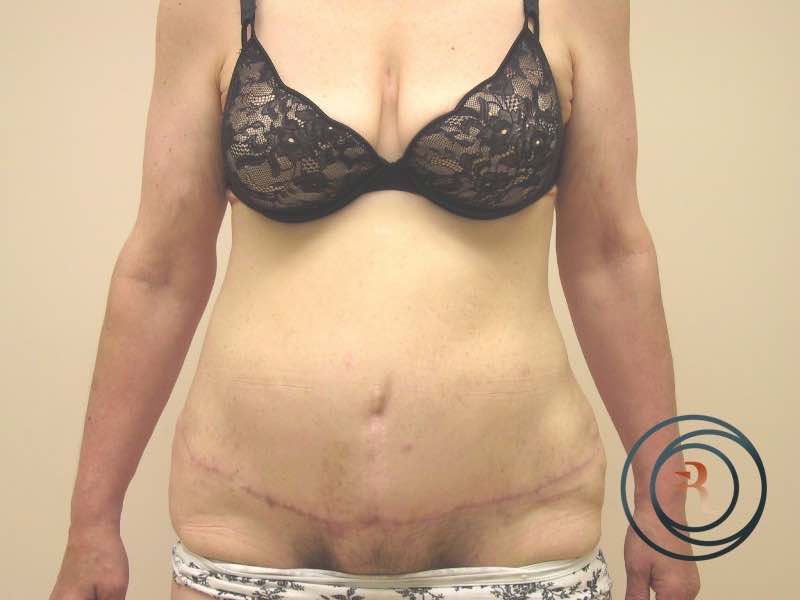
Both patients above were operated on in Morristown by Dr. Rafizadeh. In each case the lower abdomen and the mons pubis were treated as one continuous unit — not as two separate regions — so the final contour reads as a balanced, naturally proportioned lower abdomen rather than a flat belly that ends abruptly at a fuller pubic mound.
Combined Procedures: When the Monsplasty Sits Inside a Larger Plan
For many Northern New Jersey patients, the tummy tuck plus monsplasty is itself part of a larger restorative operation. Common combinations in Dr. Rafizadeh’s Morristown practice include:
- Tummy tuck + breast lift ± fat transfer for post-pregnancy mommy makeover restoration. The fat removed from the mons and flanks can be carefully processed and re-injected into the breasts for natural volume.
- Tummy tuck + liposuction of the flanks, lower back, and inner thighs for full lower-trunk contouring.
- Tummy tuck + thigh lift when laxity extends from the mons down into the inner thighs, common after massive weight loss.
- Tummy tuck + arm lift as part of a staged post-bariatric body contouring plan.
The monsplasty integrates seamlessly into any of these. Because it shares the tummy tuck incision and the same anesthesia, the marginal recovery cost of adding it is essentially zero — while the visual payoff (a balanced lower-abdomen-to-pubic-mound contour) is high.
What This Costs — And Why It’s a Better Investment Than a Revision
Adding a monsplasty to a planned tummy tuck adds a modest fee on top of the tummy tuck cost — the same operating room, the same anesthesia, the same recovery, with 30 to 45 extra minutes of surgical time. Specific pricing is reviewed during the Morristown consultation and depends on the patient’s anatomy and any other procedures being combined.
The cost comparison that matters most: a monsplasty performed at the original tummy tuck is dramatically less expensive, less disruptive, and less invasive than a monsplasty performed as a revision a year later. Patients who skip the monsplasty during their tummy tuck and then return unhappy about a prominent mons often face a second anesthesia, a second recovery, and a second fee — for an operation that could have been a 30-minute addendum the first time around.
Northern New Jersey patients exploring financing options should ask the Better Plastic Surgery office about cosmetic surgery financing during the consultation.
Questions to Ask Any Tummy Tuck Surgeon in North Jersey
If you are interviewing tummy tuck surgeons in Morristown, Summit, Chatham, Madison, Short Hills, Bernardsville, Mendham, Florham Park, Livingston, or anywhere in Northern New Jersey, the mons conversation is one of the strongest signals of a surgeon’s aesthetic eye. Useful questions to ask:
- How do you evaluate the mons pubis during a tummy tuck consultation, and what would you do for my specific anatomy?
- If a monsplasty is appropriate, will you do it through the same incision in the same operation?
- Do you combine liposuction of the mons with a monsplasty, or is the choice one or the other?
- Can you show me before-and-after photos that specifically highlight the mons area — not just the abdomen above the belly button?
- How do you anchor the mons to keep it from drifting back down over time?
- What would you do for someone who already had a tummy tuck somewhere else and is now unhappy with how the mons looks?
A surgeon who answers these in concrete, anatomy-specific terms — ideally with photographs that show before-and-after at the lower-abdomen-to-mons junction — is signaling that the mons is part of their standard preoperative planning. A surgeon who waves the question off, or who tells you not to worry because “the tummy tuck takes care of it,” may not be planning the mons at all.
Common Questions Patients Search About the Mons Pubis & Tummy Tuck
Does the pubic area get lifted with a tummy tuck?
Yes, slightly — the tummy tuck’s closure pulls the lower abdominal skin downward and the upper edge of the mons upward, which mildly elevates the pubic area. However, a tummy tuck alone does not thin the mons or remove excess pubic skin. When the mons carries excess fat or sagging skin, a formal monsplasty is needed to directly treat the area. The mons is evaluated in every tummy tuck consultation in Dr. Rafizadeh’s Morristown office.
Why is my mons pubis so large after a tummy tuck?
Three common reasons. Swelling is the first — the mons sits at the lowest point of the lower abdomen and collects fluid for the first several weeks. Contrast is the second — a freshly flat abdomen above makes the mons look more prominent than it did before surgery. Underlying anatomy is the third — if the mons was fatty or saggy going in and a monsplasty wasn’t included, the mons itself was never directly treated. Time and compression resolve the first two; the third is solved by adding a monsplasty.
Will a tummy tuck fix a FUPA?
A tummy tuck addresses the lower abdomen above the pubic bone. A FUPA (fat upper pubic area) lives over the pubic bone, in the mons itself, and a standard tummy tuck does not directly thin it. Combining a tummy tuck with mons pubis liposuction and/or a monsplasty during the same operation is what actually addresses a FUPA — with no additional scar and minimal added recovery.
How do you get rid of a fat mons pubis?
If the mons is fatty but the skin is still elastic, targeted tumescent liposuction often does the job — particularly when combined with a tummy tuck or another body contouring procedure. If the mons is fatty and the skin is loose or hanging, liposuction alone leaves redundant skin, and a formal monsplasty — removing skin, thinning fat, and anchoring the deeper tissue upward — is the right operation. Dr. Rafizadeh evaluates skin elasticity and fat distribution in every Morristown consultation to choose the right approach.
Does a tummy tuck include the mons pubis?
Not in the formal sense. The tummy tuck’s closure does mildly elevate the upper edge of the mons because of how the incision is placed and the skin is redraped, but a tummy tuck alone does not thin, sculpt, or anchor the mons. Direct treatment of the mons requires adding a monsplasty — which uses the same incision, no extra scar, and adds 30 to 45 minutes to the operation.
How much does a tummy tuck with monsplasty cost in North Jersey?
Adding a monsplasty to a planned tummy tuck adds a modest fee compared with a tummy tuck alone — the same operating room, same anesthesia, same recovery, plus 30 to 45 minutes of additional surgical time. Specific pricing is reviewed during the Morristown consultation and depends on the patient’s anatomy and any additional combined procedures. Patients should explore financing options when planning a combined operation.
What happens to the mons after a tummy tuck without a monsplasty?
If the mons was already fatty or sagging before surgery, a tummy tuck alone often makes it look more prominent — not because the mons changed, but because the freshly flattened abdomen created visual contrast. Patients who weren’t counseled about the mons going in can be surprised by how prominent it looks at six months. The right strategy is to identify a mons issue during the original consultation and plan a combined tummy tuck plus monsplasty up front.
Related Reading From Dr. Rafizadeh’s Blog
Patients researching tummy tuck and body contouring options in Northern New Jersey may find these articles useful:
- Mini Tummy Tuck, Full Tummy Tuck, or Just Liposuction?
- Extended Tummy Tuck in New Jersey
- Can Tummy Tuck Scars Be Shorter? — Morristown, NJ
- Abdominoplasty Recovery & Scar Care in Morristown
- Ozempic, Weight Loss & Tummy Tuck Planning in NJ
- Breast Lift + Fat Transfer + Tummy Tuck at the Same Time
- Does Liposuction Create Tunnels Under the Skin?
- TAP Block Anesthesia for Tummy Tuck Recovery
Bottom Line
The patient who asked Dr. Rafizadeh why she would need a puboplasty with her tummy tuck was asking exactly the right question — the kind of question that separates a good cosmetic surgery result from a great one. The mons pubis is part of the lower abdomen, not a separate region, and a tummy tuck that flattens the abdomen without addressing the mons can leave a patient with the puzzling outcome of loving her new stomach but disliking the area immediately below it.
The fix is straightforward when it is planned up front: a formal monsplasty — thinning the fat, removing excess mons skin, and anchoring the deeper tissue in a higher, flatter position — performed through the same low bikini-line incision, in the same operation, with essentially the same recovery. No additional scar. No additional anesthesia. A balanced, naturally proportioned lower abdomen that holds up for decades.
If you are considering a tummy tuck — alone or in combination with a breast lift, liposuction, fat grafting, thigh lift, or arm lift, or as part of a full mommy makeover in NJ after childbearing — in Morristown, Summit, Chatham, Madison, Short Hills, Bernardsville, Mendham, Florham Park, Livingston, or anywhere in Northern New Jersey, Dr. Rafizadeh is happy to walk through your specific anatomy, pregnancy or weight-loss history, and goals during a consultation — and to give you an honest answer about whether a monsplasty belongs in your plan.
Sources & Further Reading
- Cleveland Clinic. “Monsplasty (Pubic Lift): Surgery, Recovery & Scars.” Cleveland Clinic Health Library, 2022.
- American Society of Plastic Surgeons. “Lift Your Confidence — and Possibly Sexual Satisfaction: Mons Pubis Lift.” ASPS, 2024.
- Rizk EA. “Safe Monsplasty Technique Combined with Abdominoplasty.” Journal of Medicine in Scientific Research, 2024.
- El-Khatib HA. “Mons pubis ptosis: classification and strategy for treatment.” Aesthetic Plastic Surgery, 2011.
- American Society of Plastic Surgeons. “Tummy Tuck (Abdominoplasty).” ASPS, 2025.
- Healthline Editorial Team. “Monsplasty Surgery: Preparation, Recovery, Cost.” Healthline, 2024.
Ready to schedule a consultation in Morristown, NJ?
Book a Consultation