
One of the more sophisticated questions that arrives on Dr. Farhad Rafizadeh’s RealSelf Q&A page comes from patients who have already thought carefully about the central face — the nose, the philtrum, and the upper lip — and who understand that changing one will quietly change the others.
“I am going to book in a revision rhinoplasty and septoplasty — however I want to shorten the length of my philtrum so I was considering a lip lift. I have tooth show when my mouth is at repose. Could a combination of both the rhinoplasty and lip lift be used together for an effective result of reducing my philtrum length?”
This is exactly the kind of question that separates patients who are casually browsing from patients who are ready for a serious consultation. They have noticed two things at once: a long philtrum and visible upper teeth at rest. They want both fixed, they understand the procedures interact, and they are asking the surgeon to think about it as one operation, not two.
Dr. Rafizadeh’s Short Answer
A lip lift procedure shortens the philtrum, while a rhinoplasty tends to have the opposite effect. If you go to an experienced and talented plastic surgeon, they will consider that fact and design the lip lift accordingly. The other issue is that you already have considerable tooth show despite a long philtrum — one has to keep that in mind and plan the lip lift conservatively.
Two ideas are packed into that answer. First: the two procedures pull the philtrum in opposite directions, and the plan has to balance them. Second: when a patient has a long philtrum and meaningful tooth show, the lip lift cannot be aggressive. The shortening has to be measured in millimeters, planned with the lip in repose, and matched to whatever the rhinoplasty is going to do to the nasal base.
Why a Lip Lift Shortens the Philtrum — And a Rhinoplasty Lengthens It
The philtrum is the soft-tissue distance between the bottom of the nasal columella and the top of the cupid’s bow of the upper lip. Two anatomical truths govern how it changes:
- A lip lift physically removes a thin strip of skin from beneath the nose, lifts the remaining skin upward, rolls the upper-lip vermillion outward, and shortens the philtrum by the exact amount of skin removed — usually three to seven millimeters depending on the patient.
- A rhinoplasty, particularly maneuvers that deproject the tip, lower a hanging columella, place plumping grafts at the nasal base, or alter the medial crural footplate, can push the visible soft tissue of the upper lip downward. The change is small — usually one to three millimeters — but it adds to whatever philtrum length the patient already has.
The Lip Lift Is Not One Operation — Dr. Rafizadeh Selects the Incision by Nostril-Sill Morphology
A common misconception is that the “lip lift” is a single, standard procedure. In Dr. Rafizadeh’s practice it is not. The right incision design depends on the patient’s individual nostril-sill morphology — specifically, how the philtral skin transitions into the nostril floor, and whether a defined sill border exists to hide a scar within. The practice identifies three morphologies:
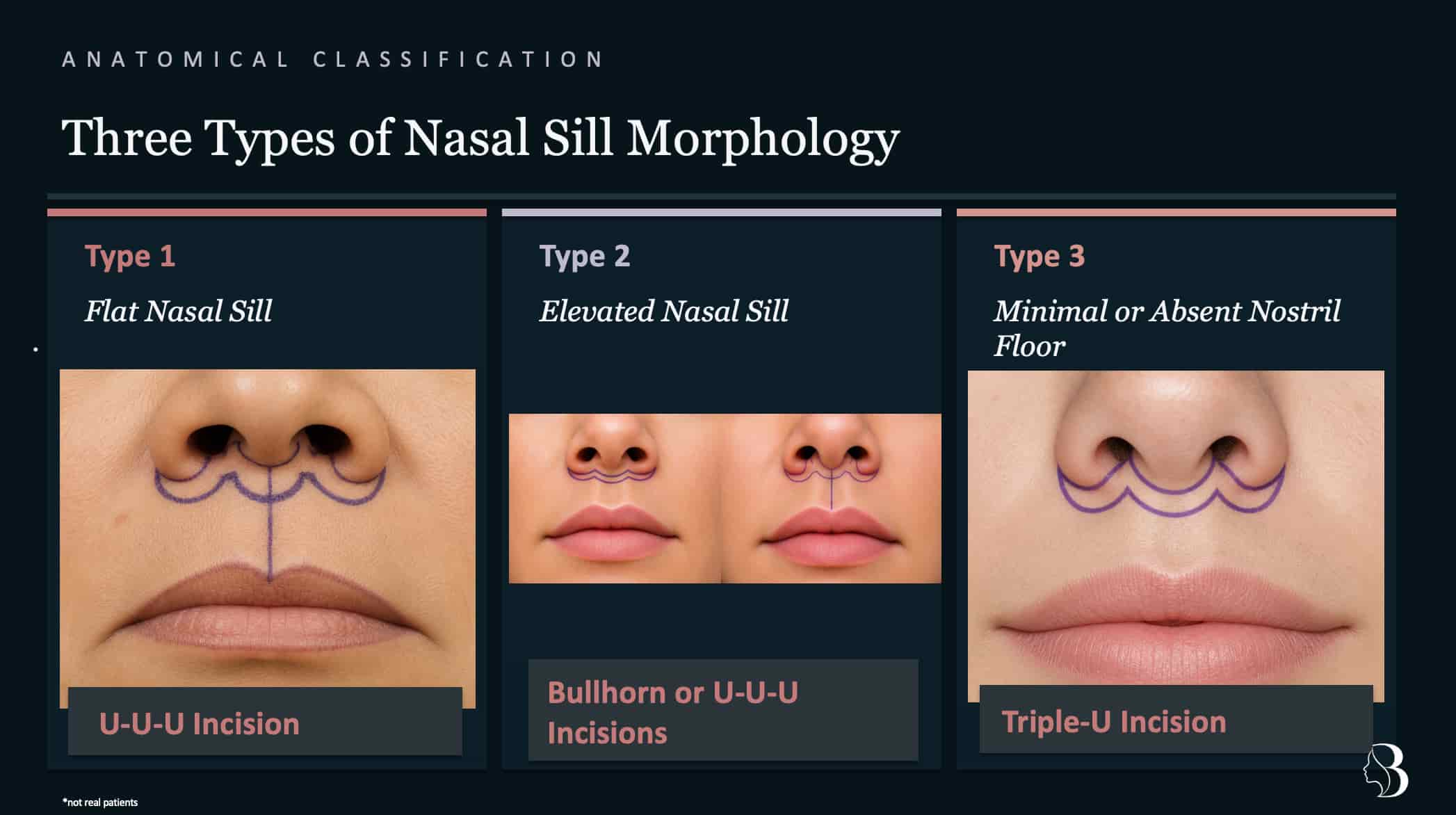
- Type I — Continuous philtral-to-nostril transition with no defined sill border. The philtrum flows smoothly into the nostril floor without a discrete sill ridge.
- Type II — Raised sill with relative depression below. A defined nostril-sill border exists, with the skin of the upper lip sitting in a relative depression beneath it.
- Type III — Absent to minimal nostril floor; alar crease meets the columellar base. There is little or no nostril floor; the alar crease runs directly to the columellar base.
Each morphology calls for a different incision design so that the resulting scar is concealed in the patient’s own native anatomy:
- Type I → U-U-U incision. Dr. Rafizadeh prefers a U-U-U incision design that hides the scar in the alar-facial groove without extension. Because there is no defined sill border to anchor a bullhorn scar, the U-U-U design respects the smooth transition and conceals the scar in the natural groove.
- Type II → U-U-U or bullhorn. Either a U-U-U incision or a classic bullhorn technique can be used here. The defined sill border allows the bullhorn scar to be concealed within a deepened alar crease, so both designs work well depending on the rest of the patient’s anatomy.
- Type III → Triple-U (sill-crossing) incision. When the nostril floor is absent or minimal and the alar crease meets the columellar base, the practice uses a Triple-U incision that crosses the sill so the scar hides within that natural junction.
For more on the procedure itself, including candidacy, technique detail, and before-and-after examples, see Dr. Rafizadeh’s dedicated lip lift procedure page. The point relevant to this article is simple: which incision the patient receives is dictated by their individual nostril-sill morphology, and it is decided before the rhinoplasty plan is finalized so the two operations work together.
If both procedures are being done in the same operation, the surgeon has to add and subtract: the rhinoplasty is going to add a millimeter or two to the philtrum, so the lip lift has to be designed slightly longer to net out at the patient’s actual target length. A surgeon who does not think this way will end up with a lip lift that looked right at the end of surgery and a philtrum that creeps back to almost its original length over the following months as the nasal base settles.
The Special Problem of a Long Philtrum With Tooth Show
The patient on RealSelf flagged the harder case. Their philtrum is long, which is the classic lip-lift indication. But they also have visible upper-incisor show with the lip at rest, which is normally a counter-indication for an aggressive lip lift.
The reason this matters: a lip lift increases tooth show. Most patients gain one to three millimeters of upper-incisor visibility at rest after a lip lift. For someone who had almost no tooth show beforehand, that gain is the rejuvenation they were after. For someone who already shows two or three millimeters of upper incisor, an additional two or three millimeters can push the result into “mouth always slightly open” territory.
The solution is not to refuse the lip lift — the patient’s philtrum genuinely is too long, and shortening it will improve the central face. The solution is a conservative lip lift, measured carefully in repose, set to give just enough shortening to fix the philtrum without exaggerating the tooth show. In an experienced surgeon’s hands this is a millimeter-level calculation.
How Dr. Rafizadeh Plans the Combined Procedure
1. Measure the Philtrum and the Tooth Show in Repose
The single most important measurement happens before any incision is drawn. The patient sits relaxed in front of a mirror, with the lip in true repose — not pressed together, not smiling, not actively held. The current philtrum length is measured from the nostril sills to the cupid’s bow. The current upper-incisor show at rest is noted in millimeters.
2. Set the Final Philtrum Target Based on the Whole Face
A youthful adult female philtrum is typically eleven to thirteen millimeters; a youthful adult male philtrum is twelve to fifteen. But the right number for any given patient is the number that matches the rest of their facial proportions — the height of the lower face, the position of the chin, the length of the nose. Dr. Rafizadeh works backward from facial harmony, not from a textbook number.
3. Anticipate the Rhinoplasty’s Effect on the Philtrum
If the planned rhinoplasty involves dropping a hanging columella, deprojecting the tip, or any maneuver that pushes the nasal base downward, the expected change is added into the calculation. The lip lift incision is designed to remove that much extra skin, so the final philtrum settles at the target length once the nose finishes healing.
4. Plan the Tooth Show, Not Just the Philtrum
If the patient already shows two or three millimeters of upper incisor at rest, the lip lift is designed to gain no more than one or two additional millimeters of dental show. For a patient with almost no tooth show, the design can be more generous.
5. Combine the Two Operations in One Setting When Appropriate
For most patients these two procedures are ideal candidates to be performed together in the same operation. The incisions are neighbors. The anesthesia is shared. The recovery is one event instead of two. And critically, the final philtrum length is set after the nasal base is already in its new position — not approximated before the rhinoplasty and corrected later.
The Anesthesia and the Setting
A standalone lip lift is comfortably performed under local anesthesia with moderate IV sedation in Dr. Rafizadeh’s accredited Morristown surgical facility. When the lip lift is combined with a rhinoplasty in the same operation, however, the anesthesia plan changes: the combined operation is generally performed under general anesthesia. The rhinoplasty itself — particularly a revision rhinoplasty involving septal and intranasal work — is longer, requires a controlled airway to protect against blood entering the airway, and is better tolerated by the patient under general anesthesia than under sedation alone.
The operation still takes place in the same accredited outpatient surgical facility in Morristown, with continuous monitoring of heart rate, blood pressure, oxygen saturation, and breathing throughout. A board-certified anesthesia provider manages the general anesthetic. The lip lift portion is completed within the same anesthetic, so the patient experiences one operative event and one recovery rather than two.
For more background on Dr. Rafizadeh’s anesthesia philosophy — and the situations where local anesthesia with sedation is the better choice — see his recent post on the safest anesthesia for older patients having facial cosmetic surgery.
What Recovery Looks Like in Northern New Jersey
Patients who travel from Morristown, Summit, Chatham, Madison, Short Hills, Bernardsville, Mendham, Florham Park, and across the rest of Northern New Jersey for a combined lip lift and rhinoplasty can expect the following recovery curve:
- Day 1–2: Mild facial swelling, especially over the bridge of the nose and the upper lip. Bruising under the eyes is common. The upper lip feels tight when smiling.
- Day 5–7: Lip lift sutures are removed. The nasal splint is removed around day six or seven. Most under-eye bruising fades or can be covered with concealer.
- Day 10–14: Most patients return to social activity — restaurants, light work events, social media. The lip looks tight and slightly elevated for another two to three weeks, then settles into a natural curve.
- Month 1–3: The lip-lift scar is in the early healing phase — pink and flat, hidden in the nostril sill crease. Silicone scar tape and disciplined sun avoidance are used during this period.
- Month 6–12: The lip-lift scar matures and lightens to the point that it is very difficult to see at conversational distance. The nose continues to refine, particularly at the tip, for up to a full year.
What This Looks Like in Real Patients
Patients often underestimate how much of their lower-face aging is actually philtrum length — not the lip itself, not lines, not lost volume, but the simple distance from the nose to the lip. When that distance is shortened by even a few millimeters, the entire central face reads younger. When the rhinoplasty is done at the same operation, the result reads not just younger but more proportionate.
Questions Patients Should Ask Any Plastic Surgeon About a Combined Lip Lift & Rhinoplasty
If you are considering this combination of procedures in Morristown, Summit, Chatham, Madison, Short Hills, or anywhere in Northern New Jersey, useful questions to ask include:
- How many lip lifts have you personally performed, and how many of those were combined with a rhinoplasty in the same setting?
- Will you measure my philtrum and tooth show with my lip at full rest before any incision is drawn?
- What is your target philtrum length for me, and why that specific number?
- Will the planned rhinoplasty changes affect my philtrum length, and how are you accounting for that in the lip lift design?
- How much additional tooth show should I expect at rest after the lip lift?
- What does your lip lift scar look like at six and twelve months in similar patients?
- Which nostril-sill morphology — Type I, II, or III — do I have, and which incision design (U-U-U, bullhorn, or Triple-U) does it call for?
- What anesthesia will be used? (A standalone lip lift is typically local with sedation; a combined lip lift and rhinoplasty is generally done under general anesthesia.)
A surgeon who has spent decades performing both of these procedures will answer in concrete numbers and specific anatomical reasoning. A surgeon who does these procedures occasionally will answer in generalities.
Common Questions Patients Search About Lip Lift & Rhinoplasty
Can you do a lip lift and rhinoplasty at the same time?
Yes — this is a common combination, and in many cases doing them together is actually better than staging them. The two procedures share the same neighborhood of the face, the same incision approach to the nasal base, and the same anesthetic. Doing them together lets the surgeon set the final philtrum length in one operation, with the new nasal base already in place. For most North Jersey patients, this means one recovery instead of two.
How long should I wait for a lip lift after a rhinoplasty?
If the procedures are not being done together, Dr. Rafizadeh generally recommends waiting six to twelve months after a rhinoplasty before doing a separate lip lift. The nasal base needs time to settle into its final position — up to a year for the soft tissue to relax — before the lip lift is designed. Measuring the philtrum earlier risks over- or under-shortening once the nose finishes healing.
Does a lip lift increase tooth show?
Yes, typically by one to three millimeters at rest. For most patients this is desirable — a small amount of upper-incisor show at repose is a youthful trait. For a patient who already has significant tooth show, the lip lift has to be designed conservatively so the dental show after surgery stays in proportion. This is exactly the calculation Dr. Rafizadeh makes when a North Jersey patient presents with a long philtrum and visible teeth at rest.
Can you shorten the philtrum with rhinoplasty alone?
Only modestly, and only in specific anatomies. Lifting a hanging columella, adjusting the nasal tip rotation upward, and trimming a long medial crural footplate can shorten the visible philtrum by a millimeter or two. But if the philtrum is meaningfully too long, a rhinoplasty by itself will not fix it — a lip lift is the procedure that directly addresses philtrum length.
Who shouldn’t get a lip lift?
Patients with a naturally short philtrum, patients who already show too much upper incisor at rest (a gummy smile), patients with very thick or hyperpigmented skin in the nostril-sill area, and patients whose proportions don’t actually need shortening should not get a lip lift. The procedure is for a specific anatomy — a long philtrum with concealed or minimal upper lip vermillion — not a default rejuvenation step.
How can I reduce the appearance of a long philtrum?
Surgically, a subnasal lip lift is the definitive answer — it shortens the philtrum directly, in millimeter increments, with a hidden incision under the nostril sills. Non-surgically, lip filler can roll the upper vermillion outward and slightly de-emphasize the philtrum’s length, but it does not actually shorten it. For most patients in Northern New Jersey unhappy with the length, the lip lift produces a more natural, longer-lasting result than serial filler.
Does a V-to-Y lip lift shorten the philtrum?
No. A V-to-Y advancement is a different procedure performed inside the mouth on the wet-dry border of the lip; it adds vermillion show by advancing tissue forward, but it does not shorten the philtrum. The procedure that directly shortens the philtrum is the subnasal (bullhorn) lip lift, performed externally just under the nostril sills.
Why does a rhinoplasty sometimes lengthen the philtrum?
Many rhinoplasty maneuvers — especially deprojection of the tip, columellar struts, plumping grafts at the nasal base, and dropping a hanging columella — shift the soft tissue of the upper lip and nasal base downward by a small but visible amount. The change is usually one to three millimeters, but on a face where the philtrum is already long, those millimeters matter. A skilled surgeon anticipates this and adjusts the lip lift design accordingly.
How is a long philtrum corrected if I already have visible tooth show?
This is the situation Dr. Rafizadeh receives most often on RealSelf: a long philtrum with significant tooth show at rest. The lip lift has to be conservative. The goal is to shorten the philtrum just enough to restore proportion without producing exaggerated dental show or a constantly ‘open’ mouth at rest. The amount of skin removed is measured in millimeters and is planned with the patient looking in a mirror in repose, not with the lip tensed.
Which lip lift incision does Dr. Rafizadeh use, and how is it chosen?
Dr. Rafizadeh's practice classifies the patient's nostril-sill anatomy into three morphologies and matches the incision to that morphology. Type I (continuous philtral-to-nostril transition with no defined sill border) is treated with a U-U-U incision that hides the scar in the alar-facial groove without extension. Type II (raised sill with relative depression below) can be treated with a U-U-U incision or a bullhorn technique, since the defined sill border allows the scar to be concealed within a deepened alar crease. Type III (absent to minimal nostril floor, with the alar crease meeting the columellar base) is treated with a Triple-U (sill-crossing) incision so the scar hides within that natural junction.
How long is recovery after a combined lip lift and rhinoplasty?
Most patients in Morristown, Summit, Chatham, and the rest of Northern New Jersey return to social activity around ten to fourteen days after a combined lip lift and rhinoplasty. Sutures from the lip lift are removed inside a week. Bruising under the eyes from the rhinoplasty fades on its own timeline. The lip looks tight for two to three weeks and then settles into a natural curve.
Is a combined lip lift and rhinoplasty done under local or general anesthesia?
A standalone lip lift in Dr. Rafizadeh's Morristown facility is comfortably performed under local anesthesia with moderate IV sedation. When the lip lift is combined with a rhinoplasty in the same operation, the combined operation is generally performed under general anesthesia. The rhinoplasty itself — particularly a revision rhinoplasty with septal and intranasal work — is longer and is better tolerated under general anesthesia, which also protects the airway. The lip lift portion is completed within the same anesthetic, so the patient experiences one operative event and one recovery.
How visible is the lip lift scar after healing?
When the incision is placed exactly in the curve of the nostril sills and closed with meticulous technique, the scar is typically very difficult to see at conversational distance after a few months. The scar matures and lightens for up to a year. Patients with fair, thin skin generally heal best in this location, but skin of all tones can heal favorably with disciplined sun avoidance and silicone scar care.
Will a lip lift give me a more youthful appearance?
Yes, when the patient is the right candidate. The philtrum lengthens with age — the distance between the nostril base and the top of the upper lip increases over decades, and tooth show at rest decreases. A well-planned lip lift restores a shorter, more youthful philtrum and brings the upper lip vermillion forward into a more visible position. Combined with a rhinoplasty, the entire central face is rebalanced.
Related Reading From Dr. Rafizadeh’s Blog
Patients researching lip lift and rhinoplasty in Northern New Jersey may also find these articles useful:
- Lip Lift Surgery in New Jersey — Dr. Rafizadeh’s Approach
- Lip Lift: Procedure, Recovery, and Candidacy
- Upper Lip Shortening: An Important Element of Facial Beautification
- Tip Rhinoplasty in New Jersey
- Hanging Columella — Morristown Rhinoplasty
- Plastic Surgery Under Local Anesthesia in New Jersey
Bottom Line
A patient asking whether a lip lift and a rhinoplasty can be done together to shorten the philtrum — especially while already having visible tooth show — is asking exactly the right question. The answer in 2026 is yes, but only if the surgeon is fluent in both procedures and willing to design them as a single decision, in millimeter-level increments, with the lip at true repose. A lip lift shortens. A rhinoplasty can quietly lengthen. The result the patient wants only happens when both effects are anticipated, balanced, and accounted for in the same operative plan.
If you are considering a lip lift, a rhinoplasty, or both together in Morristown, Summit, Chatham, Madison, Short Hills, or anywhere across Northern New Jersey, Dr. Rafizadeh is happy to walk through your specific philtrum length, tooth show, and nasal-base anatomy during a consultation — and to show you, on a personalized computer simulation, what your results could look like before any decision is made.
Ready to schedule a consultation in Morristown, NJ?
Book a Consultation