One of the most common points of anxiety for patients recovering from rhinoplasty in North Jersey is the photo they receive from their surgeon right after surgery — taken while they are still on the operating table. The nose looks different from what they imagined. Swollen. Possibly broader. The tip may look round when they wanted it refined. And then the doubt begins.
This question appears regularly on Dr. Farhad Rafizadeh’s RealSelf Q&A page, and his answer is direct:
“Are pictures taken of rhinoplasty directly after surgery (in the operating room) accurate to post-healing results?”
Immediate post-op pictures are useful to a degree. They show that things have changed significantly and also show the basic relationship of the nasal parts. But the nose continues to change up to two years after surgery, and the operating room is not the time to take a post-op picture.
That last sentence is worth reading twice: the operating room is not the time to take a post-op picture. Yet many patients — and, frankly, many surgeons — treat the on-table photo as though it is a preview of the final result. It is not. Understanding why can spare a North Jersey rhinoplasty patient weeks of unnecessary anxiety and a premature judgment about an outcome that has not yet revealed itself.
Why the OR Is the Worst Possible Time to Photograph Rhinoplasty Results
Rhinoplasty is a surgery of millimeters. A three-millimeter reduction in nasal tip projection, a one-millimeter straightening of a deviated bridge, a subtle rotation of a drooping tip — these are the differences between a nose that looks “done” and one that looks natural and balanced. Those millimeter-level refinements are completely invisible in an operating room photograph for one simple reason: immediate post-operative swelling.
Swelling begins the moment the surgeon makes the first incision. Fluid pours into the surgical field as the body mounts an inflammatory response. By the time a rhinoplasty is complete — even a short, one-hour case — the nose has already absorbed meaningful edema that distorts every subtle contour. A longer or more complex case accumulates more swelling still. The patient is also lying flat, which changes how gravity distributes tissue mass compared to standing upright.
The three specific reasons on-table rhinoplasty photos are misleading:
- Exaggerated swelling obscures refinement. The nasal tip, bridge, and sidewalls swell outward, making the nose appear wider, thicker, and less defined than it will become. Delicate work — cartilage grafts, precise suture techniques, tip definition — is buried under fluid.
- Positional distortion. Supine (lying flat) position shifts nasal soft tissues differently than the standing position in which a final result is evaluated. The tip may appear more rotated or the bridge more projected than it will look when the patient is upright.
- The “drop and refine” process has not begun. Over the following weeks and months, the nasal tip and bridge gradually drop and thin as inflammation resolves. What looks bulbous at day one can look precisely refined at month twelve.
The Rhinoplasty Swelling Timeline: What to Expect Week by Week
For patients in Morristown, Summit, Chatham, Madison, and across Northern New Jersey preparing for or recovering from rhinoplasty, here is what the healing arc actually looks like:
Days 1–7: Splint and Peak Swelling
An external nasal splint is worn during this period. Bruising around the eyes peaks around day two or three and begins to fade. Swelling is at its maximum. The nose looks nothing like the expected result. This is entirely normal. The splint comes off at the end of the first week, revealing the early shape, but it is still far from final.
Weeks 2–4: Social Presentability
Most of the visible bruising is gone. The dramatic puffiness subsides significantly. Most North Jersey patients feel comfortable returning to work and light social activities during this window. The nose looks markedly better than day one, but the tip remains firm, slightly wide, and more swollen than it will ultimately be.
Months 3–6: The 80% Mark
By three to six months, approximately 80 to 90 percent of rhinoplasty swelling has resolved. The bridge becomes well-defined. The profile looks highly refined. For many patients, this is when they begin to trust that the result is moving in the right direction. However, the nasal tip is still softening and defining at this stage.
Months 12–18: Final Result
This is the benchmark Dr. Rafizadeh uses when evaluating rhinoplasty outcomes. At twelve months, the vast majority of swelling is gone. The skin has shrunk and remodeled around the new underlying cartilage and bone framework. The subtle tip refinements that were invisible in the OR — the precise rotation, the definition, the narrowing — are now visible. Patients with thicker or oilier skin may not see complete tip resolution until eighteen to twenty-four months.
What OR Photos Can Actually Tell You
It would be inaccurate to say that on-table photos are entirely without value. Dr. Rafizadeh acknowledged as much in his RealSelf answer: they show “that things have changed significantly.” In practical terms, an operating room photo can confirm:
- That a dorsal hump was reduced (a large structural change visible despite swelling)
- That the nasal bridge has been straightened (major deviations are apparent even early)
- That the overall nasal projection has been modified
- That the planned relationship between nasal parts — tip, bridge, columella — has been set up correctly
What OR photos cannot tell you is whether the delicate refinements succeeded. Whether the tip is exactly as defined as planned. Whether the bridge is perfectly smooth. Whether the nostril flare reduction is symmetric at the millimeter level. Those determinations require a fully healed, year-out result.
What This Means When Evaluating a Surgeon’s Gallery
The single most important thing North Jersey patients can do when reviewing a rhinoplasty surgeon’s before-and-after photos is to check when the after photos were taken. A surgeon whose “after” photos were taken at one week, two weeks, or on the operating table is not showing you results — they are showing you work in progress.
Photos taken at six to twelve months minimum are the standard for honest rhinoplasty documentation. Photos at one year or beyond are preferable. If a surgeon’s gallery is populated primarily with very early post-operative images or, worse, on-table shots, that tells you something about either their patience with follow-up or their confidence in long-term outcomes.
Dr. Rafizadeh’s before-and-after gallery at the Morristown practice includes cases photographed at established follow-up intervals — not table shots. The cases below are representative of what settled rhinoplasty results look like for Northern New Jersey patients.
Patient Before & After
View Full Gallery →
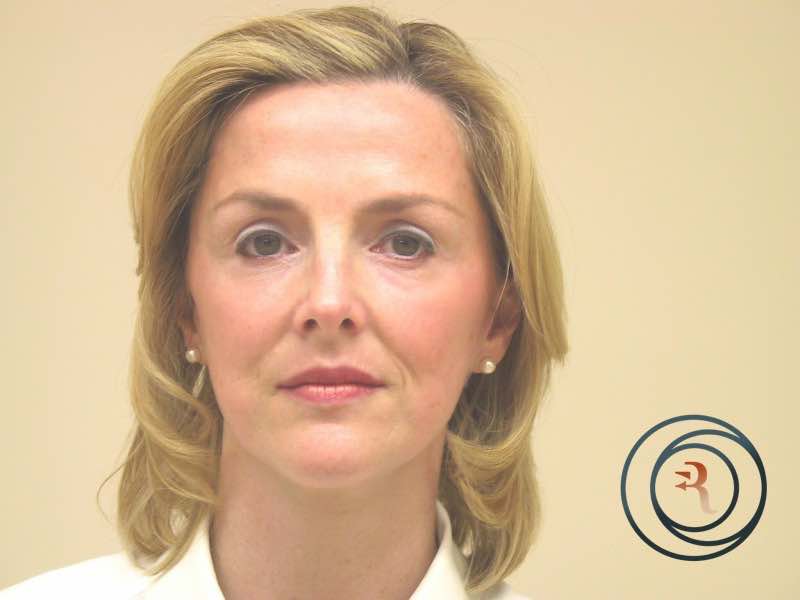

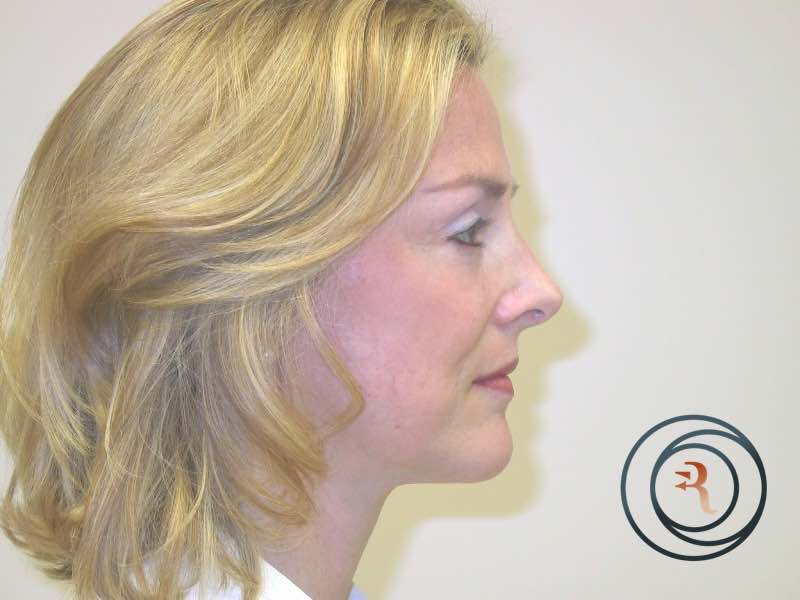
These photos were taken at established follow-up intervals — not immediately post-surgery. The nose has fully settled, and the subtle tip and bridge refinements that were invisible at day one are clearly visible here.
How Dr. Rafizadeh Approaches Rhinoplasty in Morristown
Dr. Rafizadeh has been performing rhinoplasty for more than four decades, and one of his long-standing practices is using computer imaging simulation during consultations so that North Jersey patients can see an approximation of their planned result before surgery. This simulation, taken from their own photos and discussed interactively, is a far more useful communication tool than the on-table photo their surgeon takes while they are asleep.
He performs rhinoplasty under local anesthesia with light sedation, which means the patient breathes on their own and recovers faster than with general anesthesia. For most patients coming from Morristown, Summit, Chatham, Madison, Short Hills, and the surrounding area, the combination of conservative surgical planning, computer imaging, and a measured recovery timeline sets appropriate expectations from the start.
One of the reasons patients develop anxiety about on-table photos is that no one prepared them for the swelling. The solution is not better on-table photos — it is better preoperative counseling. A surgeon who walks you through the week-by-week swelling timeline during your consultation, shows you early post-op photos alongside the one-year photos of the same patient, and explicitly tells you “the operating room is not the time for a post-op picture” is giving you the honest information you need to recover with confidence.
How to Manage the Recovery Period With Realistic Expectations
For North Jersey rhinoplasty patients currently in their recovery, here are the practical takeaways:
- Do not evaluate your result before three months. Anything you see before that point is swelling, not your nose.
- Keep your head elevated, especially at night. Gravity assists with drainage. Sleeping flat worsens morning tip swelling.
- Avoid salt and strenuous activity for the first six weeks. Both promote fluid retention and worsen swelling.
- Protect the nose from sun exposure. UV exposure can cause persistent redness and exacerbates superficial swelling in healing skin.
- Do not compare your week-four nose to someone else’s one-year result. This comparison, very common on social media, causes unnecessary distress.
- Communicate concerns to your surgeon. If you are worried about asymmetry, firmness, or unexpected contour at any stage, a brief follow-up visit with Dr. Rafizadeh in Morristown is far more useful than internet research during the recovery period.
Questions to Ask Before Rhinoplasty in North Jersey
If you are interviewing rhinoplasty surgeons in Morristown, Summit, Chatham, Madison, Bernardsville, Mendham, Florham Park, or anywhere in Northern New Jersey, the following questions will help you evaluate both the surgeon’s honesty and their results:
- At what point after surgery were your before-and-after photos taken? Can you show me patients at one year?
- Do you use computer imaging during consultation? May I see what my nose could look like?
- What does the swelling timeline look like specifically for my skin type and the changes I’m requesting?
- When do you typically schedule follow-up appointments, and will you show me early versus late photos of the same patient?
- What does the nasal tip look like at three months, six months, and one year in your experience with cases like mine?
Common Questions Patients Search About Rhinoplasty Results & Swelling
How long does it take to see the final result of rhinoplasty?
Most North Jersey rhinoplasty patients can see approximately 80–90% of their result by three to six months. The final, fully settled result — including complete nasal tip refinement — typically requires twelve to eighteen months. Patients with thicker skin may not see the ultimate tip shape until close to two years post-surgery. This is why Dr. Rafizadeh considers one-year follow-up photos the standard benchmark for evaluating rhinoplasty outcomes.
When does most rhinoplasty swelling go down?
About 75 to 80 percent of post-rhinoplasty swelling resolves within the first four to six weeks. By the three-month mark, the nose looks highly presentable and patients see the broad shape of their new profile. The remaining subtle swelling — concentrated in the nasal tip — fades gradually over the next six to twelve months. Morning tip firmness, especially, is common for six months or more.
Why is my nose still swollen 2 months after rhinoplasty?
Two months is still early in the rhinoplasty healing timeline. Persistent swelling, firmness, and bluntness in the nasal tip at eight weeks is completely normal — not a complication. The tip skin is the thickest area of the nose and the slowest to drain. Patients in Morristown and Northern New Jersey are counseled to expect ongoing tip changes through six months and beyond. Patience, not concern, is the appropriate response at the two-month mark.
Why does my nose seem swollen still 10 months post-op?
Residual tip swelling at ten months is common — particularly in patients with thicker or oilier skin. The nasal tip skin must gradually contract and redrape over the reshaped cartilage framework, and in some patients that process takes longer than a year. This is not a sign something went wrong; it is a sign the nose is still finishing its healing. Final photos should not be taken until twelve to eighteen months after rhinoplasty.
Can swelling affect rhinoplasty results?
Swelling masks the result but does not alter it. The underlying structural work — the reshaped cartilage, the refined bone, the repositioned tip — is finished. Swelling simply sits on top of the new framework and conceals it. As the inflammation resolves, the true result emerges. Following post-operative instructions — elevated head position, salt restriction, no strenuous exercise, sun protection — encourages the swelling to resolve on schedule.
What are the immediate results of rhinoplasty?
Immediately after rhinoplasty, you will see that major structural changes were made — a reduced hump, a straightened bridge, a repositioned tip — but the nose will look swollen, sometimes dramatically so. This is not your result; it is your surgical response. The immediate on-table appearance is the starting point of the healing process, not the outcome. Three to six months later, the nose will look dramatically more refined.
How long does rhinoplasty swelling last in the nasal tip?
Tip swelling is the most persistent element of rhinoplasty recovery because the tip skin is the thickest and least mobile area of the nose. Meaningful tip refinement becomes visible at three to six months. The final tip shape — its projection, rotation, and definition — often does not fully emerge until twelve to eighteen months after surgery. In patients with very thick skin, some subtle tip changes continue for up to two years.
Are photos taken in the operating room accurate for rhinoplasty results?
No. Operating room photos show structural changes but not final results. Even a short rhinoplasty produces immediate swelling the moment the procedure begins. The nose continues to change for up to two years after surgery as swelling resolves, cartilage settles, and skin redrapes over the new framework. Dr. Rafizadeh considers one-year post-operative photos the minimum standard for a fair assessment.
When should I ask a rhinoplasty surgeon to show me their before-and-after photos?
Always ask to see photos taken at least six to twelve months post-surgery — ideally one year. Photos taken at two to four weeks show bruising and cast marks, not results. Photos taken on the operating table are essentially useless as an outcome measure. If a surgeon's gallery is dominated by on-table or very early post-operative photos, that is a warning sign worth noting. When you compare rhinoplasty doctors in NJ, ask each one for one-year photographs of patients whose starting anatomy resembles yours — that single request tells you more than any gallery.
Sources & References
- Rafizadeh F. “Are pictures taken of rhinoplasty directly after surgery (in the operating room) accurate to post-healing results?” RealSelf. RealSelf Q&A
- American Society of Plastic Surgeons. “Rhinoplasty.” plasticsurgery.org
- Cleveland Clinic. “Rhinoplasty (Nose Job): Surgery, Recovery, Before & After.” clevelandclinic.org
- Toriumi DM. “New concepts in nasal tip contouring.” Arch Facial Plast Surg. 2006;8(3):156–185. PubMed
- Rohrich RJ, Adams WP. “The boxy nasal tip: classification and management based on alar cartilage suturing techniques.” Plast Reconstr Surg. 2001;107(7):1849–1863. PubMed
- American Board of Plastic Surgery. “Verify Board Certification.” abplasticsurgery.org
Related Reading From Dr. Rafizadeh’s Blog
North Jersey patients researching rhinoplasty results, recovery, and what to expect may find these articles helpful:
- Will I Look Different After Rhinoplasty? Natural Results in North Jersey
- Lip Lift with Rhinoplasty — Philtrum and Proportion in North Jersey
- Combining a Lip Lift and Rhinoplasty: Timing and Planning for North Jersey Patients
- Deep Plane Facelift in NJ — Dr. Rafizadeh’s Approach
- How Long Does Facelift Swelling and Asymmetry Last? Morristown NJ Patients Ask
Bottom Line
If you have had rhinoplasty in Morristown, Summit, or anywhere in Northern New Jersey and you are troubled by the on-table photos your surgeon shared — stop comparing them to final results. Those photos were taken at the worst possible moment: when swelling is maximum, when you are lying flat, and when the settling process that will define your result has not yet begun.
Dr. Rafizadeh’s answer is the right one: operating room photos show that major structural changes were made and that the basic nasal relationships have been reset. That is all they can show. Your nose will keep changing — mostly for the better — for up to two years.
If you are planning a rhinoplasty and want to understand what your result could look like before you ever go near an operating room, Dr. Rafizadeh uses computer imaging during every rhinoplasty consultation at his Morristown practice, and he is happy to walk you through the complete healing timeline specific to your anatomy and planned changes. Patients travel from across Northern New Jersey — Morristown, Summit, Chatham, Madison, Short Hills, Mendham, Bernardsville, and beyond — as well as from New York City and Westchester for this consultation.
Ready to schedule a rhinoplasty consultation in Morristown, NJ?
Book a Consultation