Buttocks New Jersey. Is there a golden proportion between buttocks waist and breasts?
I have written previously about the notion of beauty in the human face and body. This is a subject that interests me greatly, both in an artistic sense and as a plastic surgeon. The aesthetics of the buttocks has a huge influence on the female attractiveness. This is the most important factor in some cultures and with the growing latino influence on the American culture, the buttocks is becoming as important as the breast in this country. I would like to write about this subject and bring awareness to what I can offer women who are interested in achieving a more attractive buttocks and a more appealing proportion between their breast and the buttocks.
I was contemplating this subject and started drawing the female figure in search of beauty, proportion and balace. I made drawings from the back and side views that I thought to be most attractive and then started taking measurements with my golden ratio caliper. I use this instrument in my preoperative evaluation of patients pictures and use the golden ratios as a guide in my preoperative planning.
Here are my findings in what I would consider the most attractive female figure:
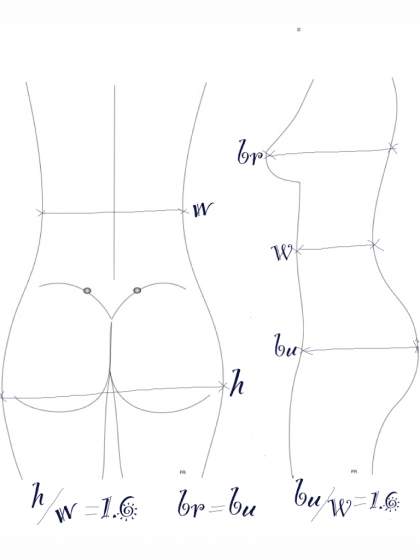
Let’s call these Dr Rafizadeh’s Aesthetic rules.
1) In the back view if you measure the narrowest width of the waist and the widest part of the hips you obtain the golden ratio of 1 to 1.6.
2) On the side view, the distance between the most projecting part of the breast and the back on a horizontal line is the same as the distance between the most projecting part of the buttocks and the front on a horizontal line. These distances make the golden ratio of 1.6 when compared with the front to back distance, in the narrowest part of the torso on the side view.
These proportions are not commonly found and are idealized, but I would like to use them as my ultimate goal in patients who are slightly over weight, which allows me to do this kind of body sculpting. We can talk about the aesthetics of the buttocks and the breasts individually at length another time but today the subject is breast and buttocks together.
Can we achieve this kind of harmony and proportion in a female body if it is not there? The answer is yes, but some of the elements have to be present. For example I can make the waist narrower, but only to a certain extent. There are people who don’t have a defined waist. In these people I could not create the golden proportion.
In a lady with excess fat and a good skin quality, we can carve out the buttock by removing the fat around it by liposuction. If necessary, fat grafting can be done to increase the buttock’s projection and improve the results. The breast can also be modified by reduction or augmentation and mastopexy to achieve any shape and size. It is not just a matter of size, but it’s about those aesthetic lines. If the lines or the curves are slightly off, the aesthetic result is not the same. It is difficult to define beauty by numbers and ratios. These ratios should only serve as a guideline. A careful examination and evaluation can determine if you are a potential candidate for these procedures.
Common Questions Patients Search About Breast Surgery
How much does breast augmentation cost in New Jersey?
Primary breast augmentation in Northern New Jersey typically runs $8,500 to $12,500 all-in, depending on implant type (saline, silicone gel, or Ideal Implant) and whether the case is combined with a lift. Dr. Rafizadeh quotes a flat price during the consultation that includes the surgeon's fee, anesthesia, the facility, and follow-up visits. Revision breast surgery costs more because the planes are scarred and the operation typically takes longer.
Is silicone or saline better for breast implants?
Both are FDA-approved and safe; the right choice depends on the patient's anatomy, preference, and how she values certain trade-offs. Silicone gel feels more like natural tissue and is the default for thinner patients with less native breast coverage. Saline ruptures are obvious immediately (the breast deflates), so some patients prefer that built-in monitoring. Dr. Rafizadeh also offers the Ideal Implant — a structured saline implant that feels closer to silicone with the safety profile of saline.
What's the difference between a breast lift and a breast reduction?
A breast lift (mastopexy) raises the breast and nipple position without removing significant tissue — ideal for women whose breasts are the right size but have descended. A breast reduction removes excess tissue along with raising the breast — appropriate for women whose breast size causes back, neck, or shoulder symptoms. The incisions are similar; the volume removed is what differs. Dr. Rafizadeh's North Jersey patients often combine elements of both when needed.
Is a breast lift easier to recover from than implants?
Recovery is similar in length (about 2–3 weeks back to non-vigorous activity), but the comfort curves differ. Implant patients report more pressure and chest tightness for the first week as the muscle accommodates. Lift patients report more skin tightness and incision care — the muscle is undisturbed but the skin envelope is reshaped. Both groups are typically back to office work in 7–10 days when surgery is performed under Dr. Rafizadeh's local-anesthesia-with-sedation protocol.
What is the 45-55 rule for breasts?
It's an aesthetic guideline: the ideal breast shape has roughly 45% of the volume above the nipple and 55% below, with the nipple sitting just above the inframammary fold. The rule helps surgeons decide implant placement, lift technique, and how much to elevate the nipple-areolar complex. Dr. Rafizadeh uses the 45/55 ratio as one of several proportional anchors during planning, alongside chest width, sternal notch-to-nipple distance, and the patient's own preferences.
How long do breast implants last?
Modern silicone and saline implants are not lifetime devices but are designed to last 10–20 years. Many patients get longer than that with no issue; some need an exchange sooner due to capsular contracture, rupture, or simply wanting a size change. The FDA recommends MRI or ultrasound screening for silicone implants starting at 5 years post-op, then every 2–3 years. Dr. Rafizadeh discusses long-term monitoring as part of every breast augmentation consultation.
What is the hardest cosmetic surgery to recover from?
Among breast procedures, breast reduction typically has the most involved recovery because of the tissue removed and the size of the incisions, but most patients say the pain trade-off is worth it given how much physical relief they feel almost immediately. Tummy tuck and combined mommy-makeover procedures rank higher overall on the difficulty curve. Compared to those, isolated breast lift or augmentation recovery is relatively gentle.
Ready to schedule a consultation with Dr. Rafizadeh?
Book a Consultation